Showing posts with label World War One. Show all posts

Saturday, April 13, 2024

Greatest Recruiting Posters of the Great War


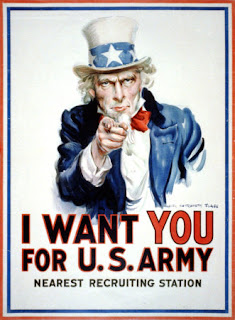
The need for millions of soldiers for "The Great War" (later renamed World War One) lead to the creation of one of the most iconic recruiting posters in American history the "Uncle Sam, I Want You" poster by famed illustrator Jame Montgomery Flagg.

 Most Americans instantly recognize this famous poster that has become an icon of two World Wars that first appeared on the cover of Leslie's Weekly magazine on 16 July 1916 as a preparedness poster (the words being "What are you doing to prepare"). The recruiting poster was first issued in 1917 with more the 4 million posters produced. 

What few Americans realize is that this poster concept was copied from the British one shown here, where Field Marshal Lord Kitchener wants you to join the British Army. Herber 1st Earl of Kitchner, was a 19th and early 20th century Imperial war hero. He was also the War Secretary of Great Britain from the start of the Great War until he died as a passenger on the HMS Hampshire when she was sunk on 5 June 1916. His instantly recognizable face directly pointing to the viewer was a powerful recruiting tool that helped induce hundreds of thousands, possibly a million+, volunteers to join as "Kitchners Soldiers." While the Kitchner poster continued to be used until the end of the Great War, the American version would continue to appear in public for decades to come.


Wednesday, April 10, 2024

"The lamps are going out all over Europe"

 Although war had already been declared between Russia, Germany, Serbia and Austria-Hungary in late July-early August 1914, it was still seen as a limited war. Upon learning of the German declaration of war upon France one of the most prophetic statements of that time was made: "The lamps are going out all over Europe; we shall not see them lit again in our lifetime," Foreign Secretary Sir Edward Grey, August 3, 1914. Later the next day the British Empire would join the folly that became "the Great War," that would last four years, redraw the map of Europe, destroy four empires (Austo-Hungarian, German, Ottoman & Russian), kill more than ten million soldiers, wound more than 23 million others, kill 11-15 million civilians and lay the groundwork for the greatest war in human history a generation later. The lights of the old Victorian/Edwardian World would never be lit again.

British "Tommies" pass through a ruined farm in the early days of "the Great War."
(These are metal miniatures from Renegade that I painted in 2010 the ruined house is a terrain piece I completed around the same period.)

Friday, April 7, 2023

Lebel Fusil Modele 1886


In the Great War the standard arm for the French in the early years was the 8mm Lebel rifle. When it was introduced in the late 19th Century, the Lebel was the most advanced military shoulder arm in general use. It was the first small bore, high velocity, smokeless powder, repeater to be accepted by a major power. But for combat use it had a major flaw, it was tube loaded. This was a slow process as the loader had to be careful loading the center fire cartridges to avoid an unfortunate explosive incident. A further complaint was made about the sight being both too short and too small for combat use. By 1914, the Lebel was out classed by most of the standard rifles of the major powers. The French Poilus took this in stride as they rose to the need to defend France from the invaders. Poor equipment would be a hinderance but would be overcome by the soldier's bravery and tenacity.


French Foreign Legionnaires armed with Lebel Fusil Model 1886 advance against the Germans in August 1914. These are metal 28mm pieces I painted for the "Great War" Centennial.

Thursday, September 11, 2014

Miracle on the Battlefield-First Marne

One hundred years, ago one of the most important battles of the 20th century was fought Northeast of Paris by the Marne River.  Throughout the month of August and first days of September 1914, the Imperial German Army marched from victory to victory, crushing Belgium, smashing through Northern France and forcing the French and British Armies into a near month long retreat. The German Schlieffen Plan for the conquest of France seemed to be on the verge of victorious conclusion, while the French war Plan XVII proved to be such a
disaster that by September 3, the French Government had fled Paris and the World waited for a swift German victory, just as they had done in 1870.
But the British and French regrouped and used a new addition to war, air recon, to reform on favorable terrain and attack the Germans in their weakest positions.  The German advance was halted, Paris was saved, and the war continued...the soldiers would not "be home before the leaves fall" (Kaiser Wilhelm II, August 1914).  The victory so changes the momentum of the war that the battle was soon called the Miracle on the Marne.  What none of the combatants could for see was that this was but the opening volley of a long, bloody war that would leave ten million soldiers dead, tens of millions more wounded, empires destroyed (Russian, Ottoman, German and Austro-Hungarian) and be the cause of an even greater conflict-the Second World War.

Saturday, August 2, 2014

The Great War-Begins in the West


August 2, 1914, Luxembourg and the opening moves of the soon to be called the Great War begins as Imperial German cavalry crosses the border. The German Schlieffen plan is about to run head on into the French Plan XVII. To the Germans this was "Der Tag" where they would gain their true place as the leaders of Europe. To the French this was the day of "Revanche" where their loss in the 1870 Franco-Prussian War would be avenged. The great Battle of the Frontiers will start in days and determine if this will be a short or long war.


Figures painted by Rick Wall.