Showing posts with label Legion. Show all posts

Tuesday, October 19, 2010

Endless Barbarian Waves


For more than three centuries the Legions of Rome fought off seemingly endless waves of Barbarian Tribes. The high quality of the legionnaires, organization of the Empire and top-quality defenses, all helped to hold back the initial waves. Yet each successive assault was stronger than the last. No matter how many victories the Romans achieved there was always another tribe to face.


>Visigoth Warrior

Germans, Alamanni, Vandals, Goths, Suebi, Visigoths, Franks, Huns, Picts, Ostrogoths, Jutes, Anglo & Saxons all slammed into the Empire adding more and more pressure until the defenses began to crack.
>Saxon Warrior

At first a trickle and then a steady stream of Barbarians entered the Empire, some to raid, some to join the Roman Army and some to set up permanent homes.

>the dreaded Huns, terror on horseback

Finally, a flood of Barbarians broke into and overwhelmed the Western Empire. The city of Rome fell to the Ostrogoths, was looted and the last Western Emperor, Romulus Augustus, was captured in 476 CE.

>Theodoric the Ostrogoth, King of Italy, lead the barbarians that ended Western Roman Empire. The Empire and Emperor were now replaced by kings and petty states. A major turning point in world history had been reached, as the Darks Ages in Europe began.

Monday, October 11, 2010

"Quinctilius Varus Give Me Back My Legions"


>Publius Quinctilius Varus suffered the greatest defeat at the hands of the Barbarians of any Roman commander during the Pax Romana (first two centuries of the Imperium). During the later years of the Imperial reign of Augustus, Publius Quinctilius Varus was given command of the new Province of Germania Magna. With three full legions, the 17th, 18th & 19th, and the bureaucracy of Rome at his disposal, Varus was responsible for the Romanization of this barbaric territory.


>Face plate from a Roman cavalry officers helmet recently found on the battlefield.
Varus was a trusted member of the extended family of Augustus but not a good choice as a military governor. He treated the Germans poorly and was very trusting of his German officers. One of the latter, Arminius-a Romanized Germanic chieftain, lead Varus and his three legions into an ambush in the marshy Teutoburg Forest. It was a massacre, the three legions, their auxiliary troops and camp followers were wiped out. Close to 30,000 Roman soldiers were lost as were the three Legion Eagles. Open revolt spread throughout Germania Magna destroying all evidence of the Romanization of the area.


When he heard of the defeat, Augustus was seen rending his clothes while screaming,"Quintili Vare, legiones redde!" ("Quinctilius Varus, give me back my Legions!"). After some brutal reprisals (and the recapture of the three Eagles), Rome abandoned all attempts to make Germany East of the Rhine into a peaceful, rich, Roman province like Gaul. A turning point in European and World History that will have ramifications through to the 20th century had occurred. The Rhine would be the new border between the Roman World and the Barbarians.  For the next 20 centuries this line would be fought over by successive hordes, empires, kingdoms and republics, ending in the last and greatest conflict-World War Two.


This ring from an officer of the 19th Legion is mute testimony to the personal cost of the disaster.

Thursday, October 7, 2010

Roman Fortified Camps-Protection for the Legion

Be it wood and dirt or stone and concrete, the Roman fortified camp was both a place of rest and refuge for the soldiers of the legion.
At the end of each day's march, the legionnaires would sleep in a fortified camp. If no permanent base was on hand the legionnaires would build a temporary one for the night.
A temporary Roman fortified camp used the dirt from excavated by the soldiers from a protective trench to form a base for a wooden stockade (each legionnaire carried two wooden stakes for the stockade wall). A double trench design was used in areas of greater danger. A single trench was more common.
For long term garrisons the camp would be made of stone, cement and fireproof tiles.


Regardless of the building materials, all Roman camps were set out in the exact same pattern. This allowed rapid construction and more importantly instant knowledge of one's surroundings in any legion camp in the Empire.


Tuesday, September 28, 2010

The Roman Legion


Marching from their fortified camps, the Roman Army Legions battled the enemies of the Empire for more than six centuries.


The basic fighting unit of the Roman Army, the legion, held from 5000 to 6000 legionnaires. The standing army normally had between 28 and 33 legions for a strength of around 150,000 legionnaires and up to an additional 300,000 auxiliary troops. At its greatest height the entire Roman Army numbered over half a million soldiers. 
In addition to fighting, Legionnaires were expected to assist in the construction of both temporary daily fortified camps and more permanent government projects such as roads, walls and aqueducts.  Besides their traditional infantry soldiers, every legion included trained specialists, such as surgeons, engineers, surveyors, bookkeepers, and craftsmen (blacksmiths, carpenters, farriers and the like). Due to their specialized duties these men were exempt from normal camp and hard labor duties.


Centurions (leader of a century-eighty legionnaires) were the officers that ran the fighting machine that was the legion. Each legion would have sixty of these indispensable officers.


Every legion was numbered and given a name such as Legion XIII-Gemini or II Augustus


The Aquilifer carried the legions Eagle-the sacred symbol of the Roman Legion.


Roman legionnaires carried two weapons for melee (hand to hand combat) the "Gladius" and the "Pilum." The Gladius Hispaniensis, or Sword of Spain, was the true killing weapon of the Roman soldier. Each legionnaire was brutally trained to ruthlessly plunge the 60cm blade into the vitals of the enemies of Rome.


The pilum was a heavy throwing javelin that Roman soldiers would throw into the enemy at point blank range. Specially designed to bend upon impact, the pilum was both difficult to remove from a shield or wounded warrior it also could not be reused against the Romans by an enemy.


Every legion was equipped with an artillery unit armed with catapults and the deadly Scorpion ballista. The latter could kill individual targets at ranges up to 300m.


The legionnaires of the Roman Legions were paid a yearly salary and were the world's first true professional soldiers. Each soldier served twenty to twenty-five years before retirement. Upon retirement, each soldier received a cash payment and a plot of farm land, often in a frontier province to help "Romanize" the territory. While the legions remained strong the Empire was secure.


Monday, September 27, 2010

Gaul-the Enemy of Caesar


>This map shows Caesar's campaign against the Gauls and his major battles.


Since the 4th century BCE, the Romans had faced the dangers of invasion by the fierce tribes of the Gaul's. In fact, Rome itself was pillaged by the Gaul's under Brennus in 387 BCE (although it would be more than seven centuries before another barbarian army was able to accomplish this feat-the Visigoths of Alaric in 410 CE). By the 1st century BCE, the Romans were in a position to finish the question of Gaul.  From 58 to 51 BCE, Julius Caesar waged a war of conquest against the "Barbarian Gaul's" and neighboring tribes. To the Romans this entire area was Gallia, just another area to be added as a province of the Empire. The Gaul's did not see themselves as "barbarians." They believed the Romans were invaders determined to conquer and enslave the people of Gaul.


The warriors of Gaul were brave but poorly trained and equipped. As in many barbarian societies, each man brought his own equipment to war. In many cases this was little more than a shield and sword or spear. Chieftains, as was appropriate to their rank and wealth, were the best equipped often with metal armour and higher quality weapons.


Roman soldiers were equipped by the state with high quality weapons and armor and were professionally trained. A Roman legion would include a medical detachment, combat engineers, transportation units and most importantly a highly developed officer corps and chain of command. Romans fought as a well-organized fighting machine; barbarians usually fought as a large mob.


It was not uncommon for some Gallic warriors to charge into combat without clothing. This was to impress their enemies with the bravery of the warrior and sow fear into the ranks of the enemy by the fanatic nature of these warriors of Gaul.

 
In the end, Roman military might and organization, under the leadership of Julius Caesar, overcame the strength of numbers the Gaul's held. Caesar used his victories to improve his fame and popularity with the people of Rome through his self-promoting book "Commentarii de Bello Gallico" (Commentaries on the Gallic War). Gaul some became an important province of the expanding Empire and remained so until the Fall of the Western Empire in the 5th Century CE.

Tuesday, September 21, 2010

Guardians of Empire

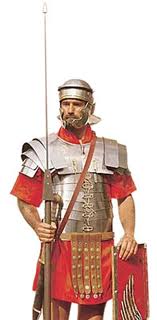
The Roman Legionnaire was the rock upon which the Empire stood. Professional soldiers who served up to 25 years, these warriors were well trained and equipped to deal with any enemy in any climate from the Arctic cold winters in Northern Europe to the scorching sands of Egypt.


On the march, each legionnaire was required to carry his weapons, armor, rations for up to a week, tent material, bedding, clothes and two posts for the camp wall (erected when the legion stopped for the night). This heavy load was often more than 80 lbs. of equipment and earned the legionnaires the title "Marius' Mules" from the name of the general who reformed the army in the 2nd century BCE.


The Roman Army was proud of the fact that they were the best trained army in the World.  From the ability to march more than twenty miles a day, and fight a battle immediately afterwards, to elaborate combat formations the legionnaires were the most combat ready force of the Ancient World.  One of the more complex formations of the legionnaires was the Roman Testudo (tortoise) a defensive formation using interlocked shields that allowed the legionnaires to advance in relative safety in the face of enemy missile fire.

The Roman Historian Livy said, the power of the Roman Army was based on three vital points: "Virtus-Opus-Arma" (Courage-Work-Weapons). As long as the Guardians of the Empire followed these truths the Empire was safe, when these failed so did the Empire.