
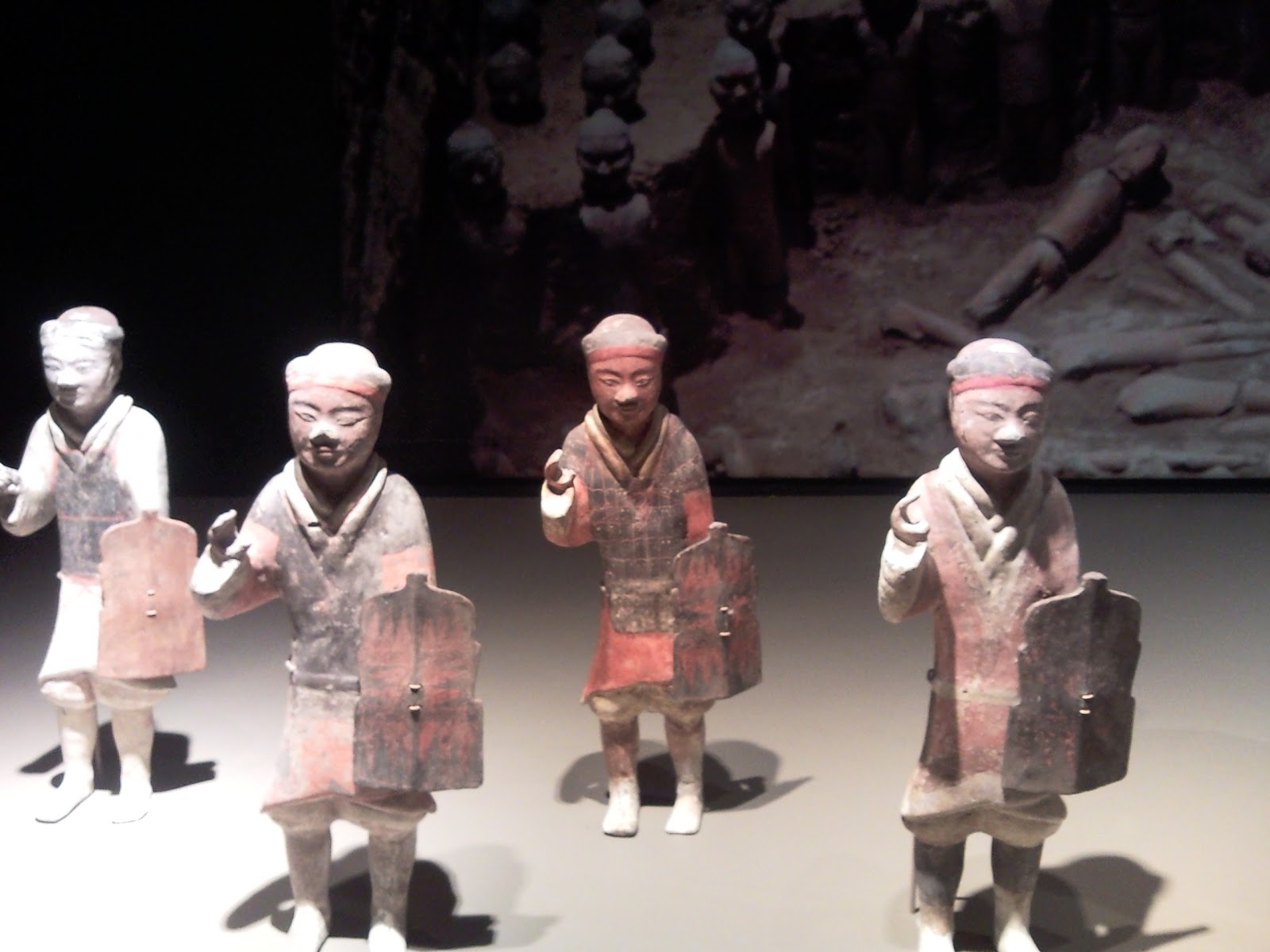
More than 20 centuries old, these Han warriors were at one time protectors of the tombs of the Han emperors. They are baked ceramic and are from a Chinese touring exhibition at the Bowers Museum.



 Nerva, the old Senator turned Emperor, put Roman Government and the Imperium back on track with the renewed concept of choosing the best man as his successor (Adoptive Succession), adopting and training them for the task of leadership. Chose Trajan as his successor and son. Nerva was Emperor from 96-98 CE, died of old age when he was sixty-eight.
 Trajan was a warrior first and emperor second. He is often thought to be the the greatest emperor after Augustus. Trajan increased the Empire to its greatest extent, produced a governmental surplus and was the model of the Roman ideals of virtue, dignity and military prowess. Emperor from 98-117 CE, he died of natural causes at the age of sixty-four.
 Hadrian (Imperator Caesar Traianus Hadrianus Augustus) believed in consolidation not expansion. He redrew the Empires boundaries to more defensible borders such as the Rhine River. One of the great builders of Rome, three of his structures are still visible today-Hadrian's Wall, Hadrian's Tomb (current Castle St. Angelo) and the Pantheon. Emperor from 117-138 CE, he died of disease when he was sixty-two.
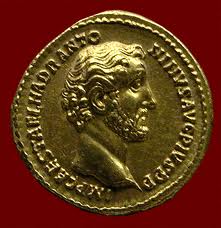 Antoninus Pius was a career politician not a warrior. A fiscal conservative, he spent his reign strengthening the Empire through negotiation rather than warfare. Taxation was fair, business booming, and the Empire was at peace. He was a popular Emperor among the people, the patricians and most importantly the legions (a most unusual occurrence). His reign is considered the high-water point of Imperial Rome. Events beyond anyone's imagination or control were about to challenge and change the Empire forever. Emperor from 138-161 CE, he died of natural causes at the age of seventy-five.
 Marcus Aurelus, last of the Five Good Emperors, was a scholar by desire and a warrior emperor by necessity as the barbarian threat was greater in his reign than it had been since the age of Julius Caesar. The constant military campaigning and waves of barbarians brought and even greater danger to Rome, one for which there was no defense-the plague. Roman medical science was powerless in the face of this invisible killer, hundreds of thousands died (a fraction of the tens of millions killed when the plague revisited Europe during the reign of the Barbarian Kingdoms descended from the destroyers of the Roman Empire). Aurelus was on the final campaign to conquer Germania Magna when he died of the disease at the age of fifty-nine, he had been Emperor from 161-180.
“For our history now descends from a kingdom of gold to one of iron and rust.” Was how the Roman historian Cassius Dio saw the death of Marcus Aurelius-the collapse of Rome had begun.
Marcus Aurelus, last of the Five Good Emperors, was a scholar by desire and a warrior emperor by necessity as the barbarian threat was greater in his reign than it had been since the age of Julius Caesar. The constant military campaigning and waves of barbarians brought and even greater danger to Rome, one for which there was no defense-the plague. Roman medical science was powerless in the face of this invisible killer, hundreds of thousands died (a fraction of the tens of millions killed when the plague revisited Europe during the reign of the Barbarian Kingdoms descended from the destroyers of the Roman Empire). Aurelus was on the final campaign to conquer Germania Magna when he died of the disease at the age of fifty-nine, he had been Emperor from 161-180.
“For our history now descends from a kingdom of gold to one of iron and rust.” Was how the Roman historian Cassius Dio saw the death of Marcus Aurelius-the collapse of Rome had begun.
 Commodus was the actual son of Marcus Aurelus and was definitely not the right man for the job. Instead of finishing the conquest of Germania he made a quick peace and returned with the army to Rome where he devoted his life to personal pleasures. His brutal reign saw the disintegration of the Imperial Adoptive Succession. The "Gladiator Emperor" thought himself a reborn Hercules and dressed accordingly. His strange behavior became to much for the Senate. Emperor from 180-192, he was murdered at the age of thirty-one by a gladiator in the pay of the Senate. The bad old days of choosing and "removing" emperors through murder and war had returned.

