
Showing posts with label 15th Century. Show all posts
Showing posts with label 15th Century. Show all posts
Sunday, July 25, 2021
The Bard-Multitalented Entertainer

Friday, September 14, 2012


Friday, May 11, 2012
The Aztec Warrior
From the common conscript soldier to the elite "knights" of the Jaguar and Eagle Warriors, the Aztec Army was a brave confident force that had only known victory for over a century of conflicts-until the arrival of the Spanish in 1519.

This Jaguar Warrior clearly illustrates the two pieces of equipment most commonly used by Aztec warriors, the small shield and the stone edged wooden Maquahuitl sword.

Commanders with standards from the Codex Mendoza. Note the elaborate costumes, use of feathers and the razor-sharp stone tipped tepoztopilli spears (usually five and a half feet long) of the officers.
 Ranks awarded for captured prisoners and imperial officers, Codex Mendoza.
The capture of prisoners was one of the main goals of Central American Pre-Colombian wars. Those who were most successful quickly rose in rank and privileges within the army and society. Here in the codex are listed the stages of honors given to a warrior for the increasing numbers of prisoners captured. Note the sixth honor is entry into the elite Jaguar Warrior Class. The Lower eight figures are officers of the empire. The rank is delineated by the ever more elaborate feathers and costume design of the officers.

Warriors armed with the Maquahuitl (obsidian sword) and shield, note the eagle warrior in the lead, from the Florentine Codex.
Ranged weapons were varied and included:

The atlatl,a spear thrower that allowed longer range than a basic hand thrown spear.
The tlahuitolli, bow, ranged from light weight with short range weapons to some heavy weight that reportedly had a range of several hundred yards. All bows fired the mitl-stone tipped arrow.
The tematlatl was a sling made from maguey fiber. This was the ranged weapon most feared by the Spanish as it was often aimed at the unprotected face with deadly accuracy.
In addition to the maquahuitl and tepoztopilli, Aztec soldiers had access to a variety of additional wood and stone hand weapons.
The huitzauhqui was a club/mace sometimes with obsidian blades. These were about the size of a modern baseball bat but could be up to twice this size when yielded by a very strong warrior.
The tecpatl was a double-bladed dagger with a nine-inch length, excellent for close in fighting.
A weakness of all Aztec weapons was their stone and wood construction. The former dulled or chipped readily and the latter was no match against steel blades.
Protective gear/armor of the Aztecs was very minimal. It was designed to be light and give a limited protection against the stone tipped weapons of the Aztecs traditional Central American enemies. This equipment was basically made of two items the Chimalli and the Ichcahuipilli.
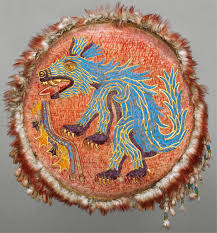
The Chimalli were small round shields made of wood or woven cane stalks often covered with cloth or feathers. They could be elaborately decorated for warriors of importance.
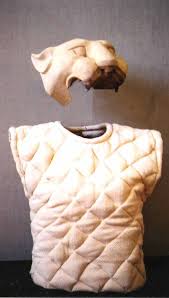
The Ichcahuipilli was a form of quilted cotton armor and inch or two thick. This padding was normally worn over the chest and back with the arms and legs unprotected. This gave such good protection against Indian stone tipped arrows that many Spanish soldiers would adopt this armor and continue to wear this style of protection when facing Indians well into the 18th century.
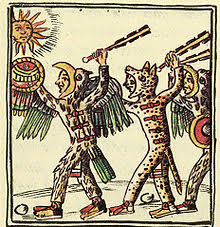 Eagle and Jaguar Warriors from the Codex Mendoza.
The tlahuiztli were the distinctive costume suits worn by the elite warrior classes. These usually covered the entire body including the head which often was covered in a form of helmet. These suits give a limited additional armor covering-especially if the costume included leather animal skins.
While adequate against their traditional enemies, the protective gear of the Aztec warriors was virtually useless against the steel weapons, iron tipped crossbow bolts, musket and cannon balls of the Spanish.
Aztec weapons could and did maim and kill their enemies who were similarly armed and protected. But in most conflicts capture of enemies was much preferred over killing them-dead men could not be sacrificed to the gods. So, it is not surprising that the majority of Aztec weapons could be readily used to stun an opponent to ease in his capture. This tactical choice and the limited strength of Aztec weapons and armor would prove a great hindrance to their army when they met the modern armed forces of the Spanish.

This Jaguar Warrior clearly illustrates the two pieces of equipment most commonly used by Aztec warriors, the small shield and the stone edged wooden Maquahuitl sword.
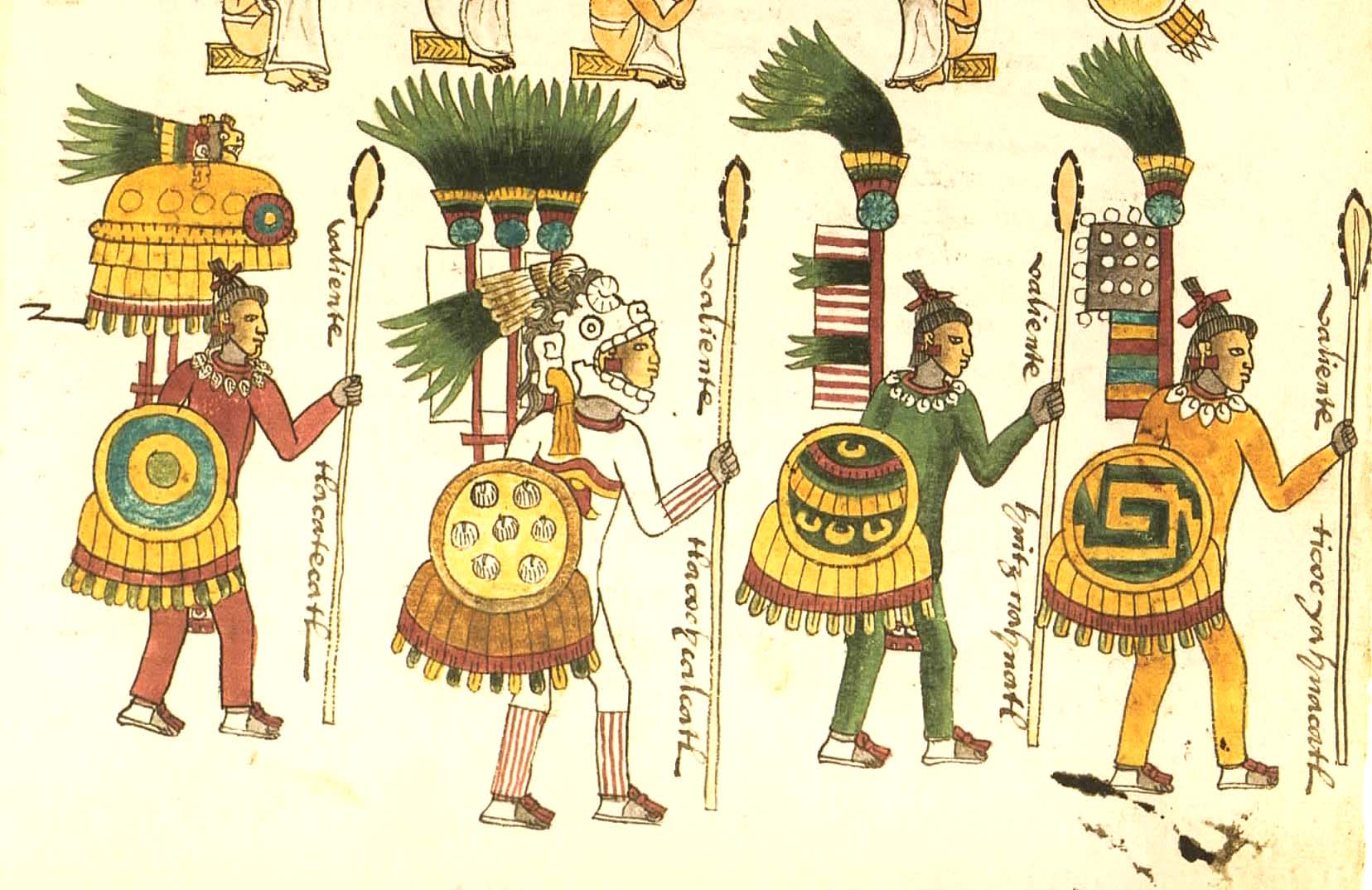
Commanders with standards from the Codex Mendoza. Note the elaborate costumes, use of feathers and the razor-sharp stone tipped tepoztopilli spears (usually five and a half feet long) of the officers.
 Ranks awarded for captured prisoners and imperial officers, Codex Mendoza.
 The capture of prisoners was one of the main goals of Central American Pre-Colombian wars. Those who were most successful quickly rose in rank and privileges within the army and society. Here in the codex are listed the stages of honors given to a warrior for the increasing numbers of prisoners captured. Note the sixth honor is entry into the elite Jaguar Warrior Class. The Lower eight figures are officers of the empire. The rank is delineated by the ever more elaborate feathers and costume design of the officers.

Warriors armed with the Maquahuitl (obsidian sword) and shield, note the eagle warrior in the lead, from the Florentine Codex.
Ranged weapons were varied and included:

The atlatl,a spear thrower that allowed longer range than a basic hand thrown spear.
The tlahuitolli, bow, ranged from light weight with short range weapons to some heavy weight that reportedly had a range of several hundred yards. All bows fired the mitl-stone tipped arrow.
The tematlatl was a sling made from maguey fiber. This was the ranged weapon most feared by the Spanish as it was often aimed at the unprotected face with deadly accuracy.
In addition to the maquahuitl and tepoztopilli, Aztec soldiers had access to a variety of additional wood and stone hand weapons.
The huitzauhqui was a club/mace sometimes with obsidian blades. These were about the size of a modern baseball bat but could be up to twice this size when yielded by a very strong warrior.
The tecpatl was a double-bladed dagger with a nine-inch length, excellent for close in fighting.
A weakness of all Aztec weapons was their stone and wood construction. The former dulled or chipped readily and the latter was no match against steel blades.
Protective gear/armor of the Aztecs was very minimal. It was designed to be light and give a limited protection against the stone tipped weapons of the Aztecs traditional Central American enemies. This equipment was basically made of two items the Chimalli and the Ichcahuipilli.
The Chimalli were small round shields made of wood or woven cane stalks often covered with cloth or feathers. They could be elaborately decorated for warriors of importance.
The Ichcahuipilli was a form of quilted cotton armor and inch or two thick. This padding was normally worn over the chest and back with the arms and legs unprotected. This gave such good protection against Indian stone tipped arrows that many Spanish soldiers would adopt this armor and continue to wear this style of protection when facing Indians well into the 18th century.
The tlahuiztli were the distinctive costume suits worn by the elite warrior classes. These usually covered the entire body including the head which often was covered in a form of helmet. These suits give a limited additional armor covering-especially if the costume included leather animal skins.
While adequate against their traditional enemies, the protective gear of the Aztec warriors was virtually useless against the steel weapons, iron tipped crossbow bolts, musket and cannon balls of the Spanish.
Aztec weapons could and did maim and kill their enemies who were similarly armed and protected. But in most conflicts capture of enemies was much preferred over killing them-dead men could not be sacrificed to the gods. So, it is not surprising that the majority of Aztec weapons could be readily used to stun an opponent to ease in his capture. This tactical choice and the limited strength of Aztec weapons and armor would prove a great hindrance to their army when they met the modern armed forces of the Spanish.
Tuesday, April 24, 2012
From Reconquista to the New World
From the first Muslim invasions of the Iberian Peninsula in the 8th century to the last decades of the15th century, the Christian rulers of the various kingdoms of this land fought to retake the land in the name of Christ. As the centuries progressed more and more of the lands were retaken through the "Reconquista."


By 1492, the monarchs Queen Isabella of Castile & Leon and King Ferdinand of Aragon (both descended from the king of Leon) had married, uniting their joint kingdoms into what would become Spain and completed the Reconquista by eliminating Granada, the last Muslim stronghold in Western Europe.
One of the benefits of the final actions of the Reconquista was the "liberation" of land, properties and much of the wealth of the Muslims. A large portion of these riches now came into the hands of the King and Queen, just in time to fund a risky venture to discover a shorter trade route to India under the command of one Cristóbal Colón.

In 1493, Cristóbal Colón returned to Spain claiming to have found a new route to Asia and the "Indies." It would take several more voyages by multiple European Explorers to eventual establish that Colón had actually discovered a hitherto unknown land-"the New World." The centuries long Reconquista to retake the Iberian Peninsula for Christianity now lead to the opening of entire "new" continents to colonization and religious conversion.

By 1492, the monarchs Queen Isabella of Castile & Leon and King Ferdinand of Aragon (both descended from the king of Leon) had married, uniting their joint kingdoms into what would become Spain and completed the Reconquista by eliminating Granada, the last Muslim stronghold in Western Europe.
One of the benefits of the final actions of the Reconquista was the "liberation" of land, properties and much of the wealth of the Muslims. A large portion of these riches now came into the hands of the King and Queen, just in time to fund a risky venture to discover a shorter trade route to India under the command of one Cristóbal Colón.
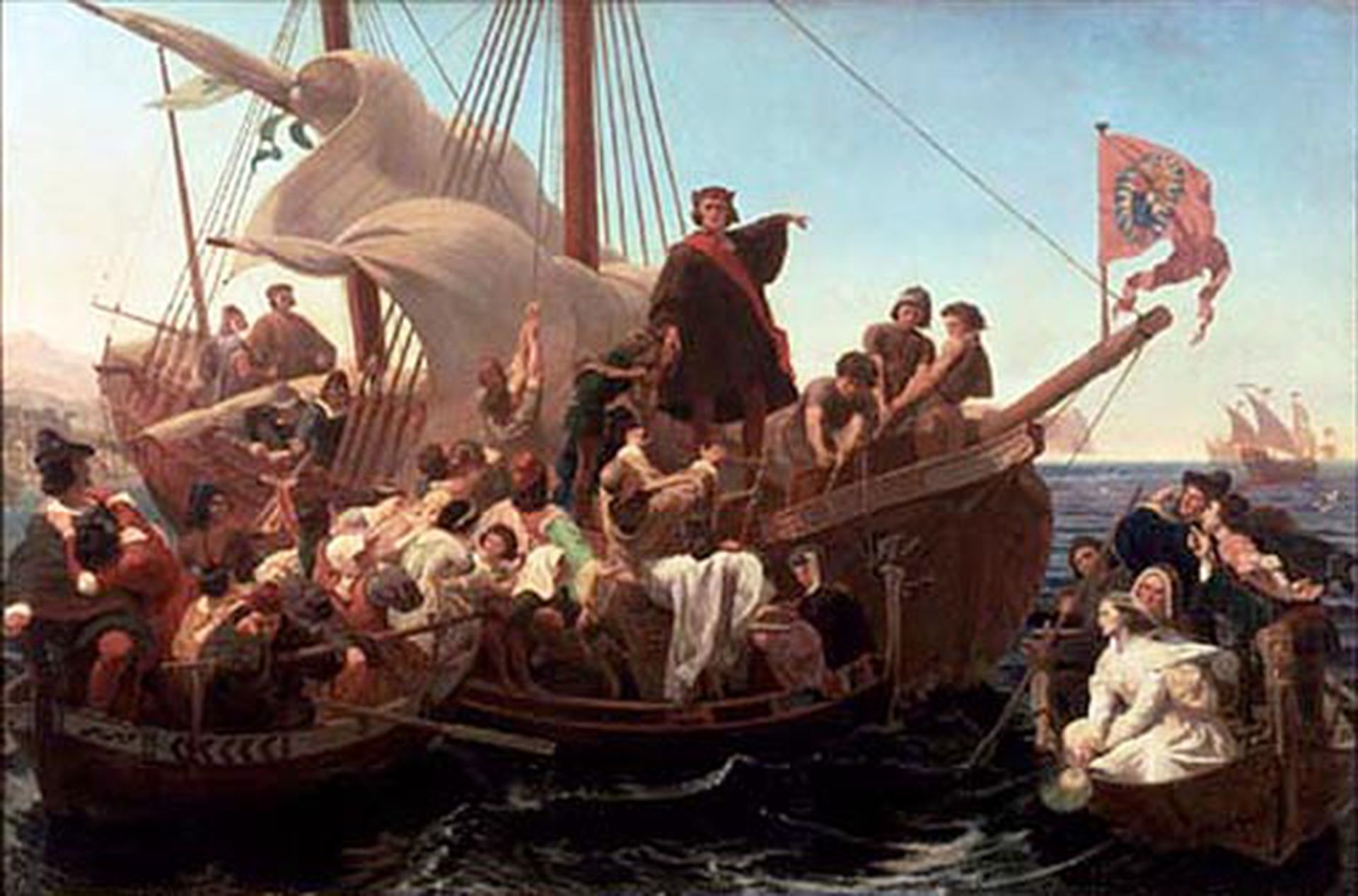
In 1493, Cristóbal Colón returned to Spain claiming to have found a new route to Asia and the "Indies." It would take several more voyages by multiple European Explorers to eventual establish that Colón had actually discovered a hitherto unknown land-"the New World." The centuries long Reconquista to retake the Iberian Peninsula for Christianity now lead to the opening of entire "new" continents to colonization and religious conversion.
Wednesday, March 7, 2012
Machiavelli and "the Prince"

Niccolò Machiavelli 1469-1527,
In a time where most believed that "Good Moral" leaders were also "Good Political " leaders and ruled with the "Grace" of God, Machiavelli wrote a divergence view of the power of a leader and the State. In his most famous work The Prince (Il Principe), he made the case that power, not the moral character, defines political action. To be an effective leader, one must understand the proper use of power and its application to the control of and success of the State. Individuals of the State must be brought to obey this power thereby maintaining the success and security of the State and all its citizens. In Machiavelli's eyes a leader that is respected (or even feared) for his power will be more successful than one who is admired for his "Goodness."
The Prince puts forth the belief that the goal of a leader should always be to “maintain his state” and to “achieve great things,” both of which require power and will increase the power of the ruler. Many have interpreted his arguments as justification for the adage-"the ends justify the means" where upon rulers are allowed to do what they wish in the stated goal of protecting the State. Others believe that Machiavelli was exposing the dangers and threats of single dictatorial rule. What is clear is that many leaders have read and followed his teachings, to both the betterment and sufferings of their peoples and States.
(Other notable works by Machiavelli included Dell’Arte della Guerra [the Art of War], Ritracto delle cose della Magna [Portrait of the affairs of Germany] and Discorsi sopra la prima deca di Tito Livio [Discourses on the First Ten Books of Titus Livy])
Thursday, February 23, 2012
War of the Roses
After the defeat of the English in the 100 Years War, thousands of warriors returned to England just in time to join in a family dispute as to which branch of the Plantagenet Dynasty-Lancaster or York-should rule England. This civil war has been called the War of the Roses due to the color of rose each family supposedly chose as its de facto emblem.

From 1455 to 1485 England was wracked by the horrors of Civil War, kings were made, deposed, reinstated, deposed again and out righted murdered in the quest for control of the throne.


The followers of the House of the Duke of Lancaster were those of the Red Rose.


For a time, the powerful Richard Neville, 16th Earl of Warwick earned the title of "Kingmaker" during this war as he threw his support to different contenders. At first, he supported the Lancastrian Henry VI (king from:1422-1461 and 1470-1471), then helped Edward IV of York (king from: 1461-1470 and 1471-1483) to the throne, after a falling out with Edward, he helped to put Henry VI back on the throne. Before he could change sides again, he was killed in the Battle of Barnet in 1471, leaving Edward IV as king.

With the death of Edward IV, his young son Edward was proclaimed king, with his Uncle Richard, Duke of Gloucester as "Lord Protector" of the boy king. The murder of Edward V (13 years old) and his younger brother Richard, Duke of York in 1483, left their Uncle Richard as the sole surviving adult male of the line and therefore king (there was an 8-year-old nephew, Edward, son of Richard's executed younger brother George. Edward himself would be beheaded in 1499).

Richard III (1483-1485) was unpopular, thought to be the murderer of Edward V and a usurper. It did not take long for his enemies to form an army and challenge him for the crown.
 In 1485, Henry Tudor, Earl of Richmond, defeated Richard III (who died in the fight) at the Battle of Bosworth Fields. Through his marriage to Elizabeth of York (daughter of Edward IV) and a distant claim of descendance from King Edward III (his mother was the great-great-granddaughter of Henry's younger son John), Henry VII of the House of Tudor is made King of England (1483-1509).
 The Tudor Rose combines the Lancaster and York into one rose, one family and a new dynasty-the War of the Roses was over.
From 1455 to 1485 England was wracked by the horrors of Civil War, kings were made, deposed, reinstated, deposed again and out righted murdered in the quest for control of the throne.

The followers of the House of the Duke of Lancaster were those of the Red Rose.
While the followers of the House of the Duke of York choose the White Rose.

For a time, the powerful Richard Neville, 16th Earl of Warwick earned the title of "Kingmaker" during this war as he threw his support to different contenders. At first, he supported the Lancastrian Henry VI (king from:1422-1461 and 1470-1471), then helped Edward IV of York (king from: 1461-1470 and 1471-1483) to the throne, after a falling out with Edward, he helped to put Henry VI back on the throne. Before he could change sides again, he was killed in the Battle of Barnet in 1471, leaving Edward IV as king.
With the death of Edward IV, his young son Edward was proclaimed king, with his Uncle Richard, Duke of Gloucester as "Lord Protector" of the boy king. The murder of Edward V (13 years old) and his younger brother Richard, Duke of York in 1483, left their Uncle Richard as the sole surviving adult male of the line and therefore king (there was an 8-year-old nephew, Edward, son of Richard's executed younger brother George. Edward himself would be beheaded in 1499).
Richard III (1483-1485) was unpopular, thought to be the murderer of Edward V and a usurper. It did not take long for his enemies to form an army and challenge him for the crown.
The Hundred Years War (the 117 Years War just doesn't sound right)

For more than a century (circa 1336-1453) England and France fought a ruinous series of conflicts (it was never one constant war-nor was there any true periods of total peace) over control of the land of France and the French crown.

Throughout the period the English and Welsh longbowmen were one of the key weapons in the English arsenal. With a range of up to 400 yards and the ability to fire up to six aimed shots a minute, the longbow was a fearsome weapon for the French to face.

In several battles (Crecy, Poitiers and Agincourt being the most famous) the smaller English army was able to overcome greater French numbers through superior tactics and the massive firepower of the longbow.

English King Henry V of the House of Plantagenet (1413-1422) was the most successful of the English kings in the war. Through the Treaty of Troyes, he was even able to force French King Charles VI of the House Valois (1380-1422) to proclaim Henry the rightful heir to the throne (upon the death of Charles). Unfortunately for the English, Henry died first (of dysentery) and the French voided the treaty.

In 1429, the teenage Maid of Orleans, Jeanne d'Arc (burned as a witch by the English in 1431), rallied the French Army and broke the English siege of Orleans. The Victory revised French spirits at a time when the English were politically divided. The final phase of the war had now begun.

Wednesday, January 4, 2012
Knights of the Realm

A troop of knights advances to the commands of their Lord.
Each man is equipped at his own expense and carries his families crest or coat of arms design to identify himself to friends and foes. Wednesday, April 6, 2011
European Renaissance Explorers-Redrawing the World one Trip at a Time

Prince Henry the Navigator of Portugal 1394-1460. His vision of sending merchant ships around Africa to India in the 15th century would begin the Age of Discovery. It would also start the race for colonies outside of Europe that would result in the great European colonial empires of the 19th & 20th centuries.

Bartholomew Dias 1550-1600. This explore from Portugal was the first European to round the Cape Horn of Africa. From this point on it would only be a matter of time before a sea trade route to India would be established.

Route of Dias around Africa.

Vasco de Gama, circa 1460-1524. First European to actually reach India by sea. Portugal, being first, would establish a profitable trade route with their colony in India that would last for three and a half centuries.

Vasco de Gama's first route to India.

Christopher Columbus, 1451-1506. The Italian explorer working for Spain, whose massive mistake changed the history of the World. He thought he was in India but actually discovered the massive Western Continents-"the New World." A fact he would never admit.

Artist impression of the Santa Maria, the flagship of Columbus and the first European ship lost in the Caribbean Sea.

Ferdinand Magellan, Portuguese by birth, but sailed for Spain, 1480-1521. Original leader of the first expedition to circumnavigate the globe.

Sir Francis Drake,1540-1596. Greatest English "Sea Dog" and first Englishman to circumnavigate the World.

The new and improved English "racing galleon." Faster and better armed than their Spanish contemporaries. An example of Queen Elizabeth Tudor and England's new ideas of quality vs quantity in the race to control the trade routes and growing European Worldwide empires.
Friday, March 18, 2011
Leonardo da Vinci
Lenardo da Vinci the ultimate Renaissance man-April 15, 1452 – May 2, 1519

Self-portrait red chalk on paper circa 1512-1515, Royal Library of Turin

His creative mind was centuries ahead of the rest of the World. Here is his design for a bike, from one of his early 16th century folios. Mass produced versions looking like this design were not made until the late 19th century.

As a scientist and inventor he was enamored with the concept of mans ability to fly. Here is one of his designs for a man powered machine.

Human and animal anatomy was also a passion of Leonardo. He felt that a better understanding of what was under the skin, flesh and muscle would make him a better artist.

Here we see his "drawing" from the inside out concept on this incomplete St. Jerome sketch. The bones are clearly visible as Leonardo is starting to "flesh out" his creation. This drawing is another of the many works that the great master never completed.

Portrait of Ginevra de' Benci, circa 1474/-478, oil on panel, National Gallery of Art, Washington DC

The young man in this photo clearly shows the average size of most of Leonardo's portraits.

Virgin of the Rocks circa 1495-1508 oil on panel National Gallery, London. This is an improved version of his earlier work Madonna of the Rocks. Both as famous for the detailed and beautiful backgrounds that were a hallmark of many of his works.

These two pages of original line sketches by Leonardo are examples of his varied interests in all aspects of his World.
Among the objects depicted are, men, feathers, wings, gauges, complex machinery and elements of nature.


Self-portrait red chalk on paper circa 1512-1515, Royal Library of Turin

His creative mind was centuries ahead of the rest of the World. Here is his design for a bike, from one of his early 16th century folios. Mass produced versions looking like this design were not made until the late 19th century.

As a scientist and inventor he was enamored with the concept of mans ability to fly. Here is one of his designs for a man powered machine.

Human and animal anatomy was also a passion of Leonardo. He felt that a better understanding of what was under the skin, flesh and muscle would make him a better artist.

Here we see his "drawing" from the inside out concept on this incomplete St. Jerome sketch. The bones are clearly visible as Leonardo is starting to "flesh out" his creation. This drawing is another of the many works that the great master never completed.

Portrait of Ginevra de' Benci, circa 1474/-478, oil on panel, National Gallery of Art, Washington DC

The young man in this photo clearly shows the average size of most of Leonardo's portraits.
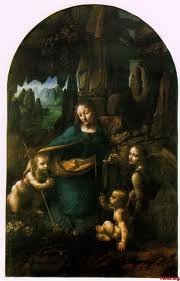
Virgin of the Rocks circa 1495-1508 oil on panel National Gallery, London. This is an improved version of his earlier work Madonna of the Rocks. Both as famous for the detailed and beautiful backgrounds that were a hallmark of many of his works.

These two pages of original line sketches by Leonardo are examples of his varied interests in all aspects of his World.
Among the objects depicted are, men, feathers, wings, gauges, complex machinery and elements of nature.


These reconstructions of his famous mechanical "robot" knight demonstrate some of our continued infatuation with Leonardo, Renaissance Master.
Subscribe to:
Posts (Atom)