Showing posts with label Warfare. Show all posts

Saturday, July 1, 2023

Butternut vs Union Blue


A Union Zouave faces off against a Rebel infantryman as the bloody War Between the States continues its path of destruction through the country. 

While the Union man is wearing the fancy French stye North African Zouave uniform, the Southerner is reduced to wearing home spun clothing dyed in "Butternut. With the lack of grey dye in the South, most of the soldiers of the Confederacy were reduced to using Butternut Dye for their uniforms. Butternut came from crushing the bark of trees and nut hulls, and when used on cotton clothing it gave a soft brown hue to the clothes. An unintended aspect of Butternut uniforms was that they foreshadowed the later introduction khaki unforms that made soldiers less of a clear target on the battlefield.

While their uniforms vary greatly their weapons are basically the same, the .58 cal. muzzle loading rifled cap and ball musket. The muskets .58 cal./14.73 mm "Minie Ball" could bring death to a target hundreds of yards away (up to 400 yds/366 m for marksmen). While many older as well as the latest repeating firearms were used in the war, the rifled muzzle loader continued to be the main infantry weapon of both sides throughout the war.

(The two soldiers are old 1970's. 25mm metal models that I painted.)

Thursday, February 9, 2023


Vietnam 1962-the Advisors Phase

Armed with the reliable .45 cal. M3 Submachine Gun, popularly known as the "Grease Gun," this model of an American Advisor has taken an active part in an Army of the Republic of Vietnam (ARVN) patrol. In the last years of the Eisenhower Administration some 700 US military advisors were active in South Vietnam. In 1962, the new Kenedy Administration sent an additional 500 to assist the ARVN. in an effort to prevent a Communist takeover of South Vietnam.
 
With continuing requests for more advisors and support personal from the South Vietnamese Government and US military, the numbers of American forces committed grew steadily, reaching 11,000+ by the end of 1962. To that date 53 US military personnel had be killed in Vietnan. More troops were seen as needed by the American Government to prop up the South Vietnamese government and prevent the success of the dreaded " Domino Theory" that foretold the fall of surrounding countries to Communist take overs once South Vietnam fell.
Within a year the number of American service personnel in Vietnam had reached 16,000 and the next phase of US escalating the war into full combat involvement was on the near horizon.
This is a kit bashed 28mm plastic piece I painted in January '23.

Saturday, July 30, 2022

Norseman Raider-that's Viking to You


The dreaded cry the "Vikings are coming" was enough to empty any Middle Ages village of its inhabitants as they took to countryside to escape the terrible raiders. For hundreds of years these fearsome men for the North plundered the coast lines of Europe.

But this Norseman, Karl Karlson, could have told their victims that "Viking" was not a nationality-it was a job description. To go "Viking" meant to go raiding. These "Viking"" raiders could be Norse (Northmen /Normans), Swedes, Danes or Friesians but none were from a land called Viking.
Karl here is a plastic piece that I painted in 2021.

Friday, May 6, 2022

Age of Victoria Part Two-Political 1868-1901


1861 Victor Emmanuel II proclaimed King of Italy. 
1862 Otto von Bismarck becomes Prime Minister of Prussia. 
1863-67 France occupies Mexico. Homestead Act.
1864 Danish-Prussian War results in quick Prussian victory. Prussia and Austria respectively rule Schleswig and Holstein. 
1866 Austro-Prussian War breaks out over the Austrian administration of Holstein. Prussian victory in seven weeks. 3rd Māori War. 3rd Italian War for Independence.
1867 Dual Monarchy established in a compromise between Austria and Hungary. US purchases Alaska claims Aleutian Islands & annexes Midway Island. 
1869 Japanese Boshin War, Suez Canal completed. Transcontinental Railroad completed.
1870 the Italian state annexed Rome. Italian unification completed. France declares war on Prussia over Ems dispatch. France was defeated at Sedan and Emperor Napoleon III captured.  Third French Republic proclaimed. 
1871 Proclamation of the German Empire at Versailles.  
1873 3rd Anglo-Ashanti War.
1874 Benjamin Disraeli becomes the Conservative PM. Britain annexed Fiji Islands.
1875 Britain took control of the Suez Canal, creating a British protectorate over Egypt. Dakota Gold Rush.
1876 Victoria proclaimed Empress of India. Belgium claimed the African Congo. 
1877 Reconstruction ends. 
1878-79 2nd British-Afghan War.
1879 Zulu War. 
1880 France claims Tunis. 1st Boer War. Art Nouveau style appears
1882 Anglo-Egyptian War, France controlled Algeria, claiming French Somaliland. Chinese Exclusion Act.
1884 Sudan Mahdi War. 
1884-1885 Germany established a protectorate over Southwest Africa, Togoland, Cameroons and East Africa. Britain claims British Somaliland, Sino-Franco War.
1885 Berlin Conference-Bismarck establishes “ground rules” for dividing Africa. 3rd Burma War. Serbo-Bulgarian War
1886 Britain made Burma a province of India after winning the 3rd Anglo-Burma War.  Haymarket Riot, American Federation of Labor formed. 
1887 Britain claims Nigeria. 
1888 Kaiser Wilhelm II ascends to the throne of the German Empire. 
1889 Italy claimed Italian Somaliland, Britain claimed Northern and Southern Rhodesia’s. 
1890 Kaiser Wilhelm II “retires” Otto von Bismarck, 1st Fanco-Dahomean War, Britain established the colony of Uganda, Ghost Dance War, Sherman Anti-trust Act.
1892 2nd Franco-Dahomean War.
1893 Franco-Siamese War, France takes Laos, with Cambodia & Vietnam the area is called French Indochina. 
1893-94 1st Matabelle-Spanish War.
1894 Britain claims Zimbabwe. 1st Sino-Japanese War, Japan takes Taiwan from China, becoming a European style colonial power.
1895 Britain established the colony of Kenya, 1st Italian-Abyssinian War. 
1896 Anglo-Zanzibar War.
1895-96 4th Anglo-Ashanti War.
1896-99 English Sudanese War, England claims the entire Sudan.
1897 Greco-Turkish War
1898 Britain obtains a 99-year lease for Hong Kong from China. Spanish American War-US “liberates” Cuba, takes Puerto Rico, Guam & Philippines. US annexes Hawaii. Fashoda Incident-France and Britain divide all unclaimed North Africa. 
1899-1902 2nd Boer War, Britain invents the concentration camp.
1899 'Open Door Policy' in the Far East, 1st Hague Peace Conference. US annexes Wake Island. 
1899-1913 Philippine-American War
1900 5th Anglo-Ashanti War (War of the Golden Stool), Boxer Rebellion-united armies of Europe & Japan crush the Chinese, capturing & looting Peking. US annexes American Samoa. 
1901 Death of Victoria age 81. Aside from Ethiopia, Japan, Persia, Siam and parts of China the entire world is under European control. 

By 1910 Queen Victoria’s grandchildren were on the thrones of the following states:
Wilhem II, Kaiser of the German Empire, George V King of Great Britain, Emperor of India, Nikolai II Aleksandrovich, Tsar of All the Russia's, Maud Queen Consort of King Haakon VII of Norway


Age of Victoria Part One- Political 1818-1867


1819 Birth of Victoria. US annexes Florida. 
1820 "Missouri Compromise"
1823 "Monroe Doctrine."
1825 Erie Canal.
1828 Greece gains its independence (lost in 338 B.C.). 
1833 Great Britain Abolishes Slavery
1836 Texas gains its independence from Mexico. 
1837 William IV dies, accession of Queen Victoria. age 18; Britain refuses to grant more home rule in Canada, leading to the Rebellions of 1837.
1840 Britain claims New Zealand, 1st Opium War (Britain vs China).
1841-42 1st British-Afghan War (total destruction of the invading English Army of 16,000).
1843 Britain claims Natal, 1st Māori War. 
1845 US forces Japan to open to foreign trade, Japanese chose to copy European concepts, & technologies-especially military. US annexes Texas.
1845-1850 Potato Famine in Ireland 1/3 of the population dies 1/3 immigrates (largely to the USA).
1846-48 Mexican American War. 
1848 Year of Revolutions, French 2nd Republic proclaimed, California Gold Rush.
1848-1864 Taiping Rebellion kills between 25 and 30 million Chinese.
1849 England annexes Punjab.
1850 "1850 Compromise."
1852 2nd Burma War. Napoleon III becomes Emperor of France. 
1853-1856 Crimean War: Britain, France and the Ottoman Empire vs. Russia. Russia's expansion into the Balkans is blocked and the 'Concert of Europe' destroyed.
1856 The Treaty of Paris ends the Crimean War, 2nd Opium War (GB & Fr vs China), Britain vs Persia War. 
1857-59 Sepoy or Indian Mutiny. 
1858 Victoria proclaims permanent British rule of India. Colorado gold & silver finds.
1859 War of Piedmont and France against Austria. 
1860 Garibaldi lands his forces in Sicily invades southern Italy. These southern states join the northern union forged by Piedmont under the direction of Camillo Cavour. 2nd Maori War. 
1861-1865 American Civil War.
1861 Victor Emmanuel II proclaimed King of Italy. 
1862 Otto von Bismarck becomes Prime Minister of Prussia. 
1863-67 France occupies Mexico. Homestead Act.
1864 Danish-Prussian War results in quick Prussian victory. Prussia and Austria respectively rule Schleswig and Holstein. 
1866 Austro-Prussian War breaks out over the Austrian administration of Holstein. Prussian victory in seven weeks. 3rd Māori War. 
1867 Dual Monarchy established in a compromise solution between Austria and Hungary. US purchases Alaska claims Aleutian Islands & annexes Midway Island.  

Friday, October 22, 2021

Results of the French and Indian/Seven Years War


The Seven Years War, all nine years of it when counting the flash point conflict in North America called the French and Indian War, was truly the first of many devastating "World Wars." Fought on every known and settled continent, the war changed the lives of tens of millions. From the French deported from Canada by the British who became the Cajuns of New Orleans, to the conquest most of the vast population of India by the British East India Company, the repercussions of this war have lasted down to our World today.

Results of the French and Indian War/Seven Years War (aside from the one million+ dead):

1. France is forced to make humiliating concessions to the British-
Forced to give up all Claims to Canada, all lands East of the Mississippi and all trade claims to India. To the Spanish, France gave New Orleans and all land claims West of the Mississippi. The bitterness of these loses and hatred for the British will lead the French to search for ways to gain revenge, through war if possible.

2. Spain, in return for New Orleans, gave Florida to Great Britain.

3. Most European and Caribbean borders are returned to prewar claims.

4. The British become the undisputed number one World Power and largest empire.  The Royal Navy will remain the premier naval power for the next two centuries.

5. With the removal of the French threat, British-American colonials look forward to moving West to settle the former French territories. 

6. All combatant nations are saddled with massive war debts that needed to be paid for through higher taxes.
 
7. One formally unknown British Colonial officer earns valuable experience and a thrill for the sound of battle. His first defeat will be forgotten after his brave actions in the Battle of Braddock's Defeat. His newfound fame and military training will serve George Washington well in the next war.

The first Worldwide war is over, the stage is now set for the "Road to Revolution!"

Tuesday, October 12, 2021

Revolution - Rebellion, Who Will Win?


Bacon's Rebellion 1675-76, Early Success Leads Death and Failure

Virginia Colony in 1675, was in turmoil. Native American troubles on the frontier, dissatisfied farmers, restless indentured servants, freed Blacks and slaves, a worried Gentry Class and a seemingly dysfunctional Colonial Royal Governor led to the first armed revolt in Colonial North America. 

The main protagonists were 70-year-old Royal Governor Sir William Berkeley and his cousin by marriage, 28-year-old land grant owner Nathaniel Bacon Jr.  Governor Berkeley, wanting to avoid another bloody war like the Anglo-Powhatan Wars (1610-1646), tried to appease friendly tribes and at the same time establish a defensive zone around the colony to protect against "bad Indians." Trade with the natives was strictly regulated and taxes raised to support the enhanced military protection.

Bacon, on the other hand wanted to attack the "Indians" with his own militia of unhappy frontier farmers and settlers. He did so after his foreman was killed in a raid. Unfortunately for all concerned he attacked an innocent, friendly tribe.  The situation continued to worsen. An angry Berkeley called on Bacon to give up his command and submit to his orders. An equally enraged Bacon gathered his forces of frontier farmers, indentured servants freed ex-slaves and even slaves and marched on the capital, Jamestown. Berkeley fled, after saving colonial documents, Bacon burned the capital, which lost him much needed support.

Soon after abandoning the ruined capital, Bacon suddenly died of "Bloody Flux and Lousey Disease" (Dysentery and Body Lice). The rebellion collapsed, 23 of its leaders were hanged, Governor Berkeley was recalled to England to explain the fiasco to the king and in 1699 the capital was moved from rebuilt Jamestown to Williamsburg. The first American revolt was a dismal failure for all concerned.


Glorious Revolution 1688, Success at No Cost
When the beloved British King Charles II died in 1685, without a legitimate child, his loathed brother, James II came to the throne. James was married to a Catholic, acted like a Catholic and introduced laws like the "Declarations of Indulgence," that eliminated punishments for "nonconformist" religious groups. The birth of James' son, Charles, who would be raised as a Catholic, threatened the supremacy of the Church of England and the vast majority of British Protestants. 
 
In response to James' rulership and faith choices, religious and government leaders invited William Duke of Orange (James' nephew and son-in-law) and his wife Mary to replace James as ruler of the British Empire. They accepted and landed in 1688, to the adoration of the crowds. James with little political support called on the army to keep him in power, the army joined William and Mary instead.  James fled to France, William became King William III, and Parliament passed a law preventing Catholics from taking the throne. Without a drop of blood being spilt, the Glorious Revolution replaced an unpopular king and changed British history forever. More direct British government involvement in American colonial political and military affairs was on the horizon.

As a side note, the term "Revolution" is usually used when the revolt succeeds while "Rebellion" normally denotes that those in revolt lost to the established government. The Glorious Revolution, American Revolution, French Revolution and Russian Revolution all were won by those in revolt. Bacon's Rebellion, Shays Rebellion, the Whiskey Rebellion and Confederacy Rebellion were all lost to the government of the time.

Monday, July 19, 2021

Highlander vs French and Native Americans in America

Colonel Hugh Montgomerie, 12th Earl of Eglinton, commander of the 77th Regiment of Foot (Montgomerie's Highlanders). Formed by Hugh in 1757, the 77th regiment was part of the British Army of North America during the French and Indian War (1754-1763). One of the first Highland regiments to serve in North America, the 77th participated in the capture of French Fort Duquesne, renamed Fort Pitt, in 1758. 

Colonel Montgomerie then led the 77th in the North Carolina Cherokee War of 1760-61, a sub-conflict of of the French and Indian War. After several battles, in which more than 5000 Cherokees were displaced, fifteen of their towns burned to the ground by the British as were 15,000+ acres of crops, the Cherokee were forced to sign a peace treaty favorable to the British.  In August 1763, the 77th took part in the Battle of Bushy Run that rescued Fort Pitt from a siege by several tribes of Native Americans.  

By the end of the French and Indian war, the 1200+ man regiment had lost over 100 men killed and 250 wounded. After four years of service in the Middle, Southern and Caribbean Colonies, the regiment was disbanded with honors. Some of the men would return to their homes in Scotland with stories of the wonders and dangers of Colonial America, enticing many Scots to immigrate to the Colonies. Many of those new immigrants would be joined by those of the regiment who also returned to this new land of endless opportunities.


Hugh Montgomerie, 12th Earl of Eglinton, Baron Ardrossan, Lord Lieutenant of Ayrshire, Knight of the Thistle, Peer of the Realm, Member of the House of Lords, Member of Parliament (b.1738 d.1819). Hugh was a successful politician and strong supporter of the British Crown. During his long life he witnessed the last battle between the Scots and English in the Jacobite Rebellion of 1754, the French and Indian War, the Seven Years War, the American Revolution, the creation of the United States of America, the French Revolution, the French Revolutionary Wars, the Napoleonic Wars, the War of 1812 and the restoration of the French monarchy.  His line still holds the title of Earl of Eglinton through his Great, great, great, great, great grandson Hugh Archibald William Montgomerie, 19th Earl of Eglinton.

Wednesday, July 14, 2021

Pathans-Bane of Imperial Britain


For much of the 19th and early 20th centuries, the fanatic Pathan (Afghani Pashtun Tribes) warriors of the Northwest Frontier of the Raj (British Imperial India), Pathans were a constant menace to Imperial control. Raids, wars, punitive expeditions, threats, bribes and the like were commonplace events as these warlike tribesmen resisted Imperial authority. 
Rather armed with flintlock rifles like these men or more modern rifles as time progressed, no British officer took lightly the thought of fighting these warriors, not if they wanted a long life that is. Many a great career in Imperial service was started, or cut short, during these conflicts on the Northwest Frontier-including that of a young Winston Churchill in the late 1890's. Never fully conquered, the Pathans remained a thorn in the side of Imperial Britain until the end of the Raj in 1947, when it became a problem for other nations well into the 21st century. 

Thursday, June 17, 2021

Pirate or Privateer

From the 16th to early 19th centuries "Privateers" were the mother countries legal pirates given "Letters of Marque" that allowed them to prey on the merchant shipping of "enemy" nations. Such commerce raiding was lucrative for both the privateers who provided their own ships and crews and for the navy that added to their commerce raiders at no expense to the naval budget.  

The object of a privateer was to capture their victims, man them with a "prize crew," and sell the ship and cargo at a friendly port. The government that granted the "Letters of Marque" most often received a percentage of this "prize money." Be they the "Seadogs" of England's Elizabeth I or American adventures of the Revolutionary War and War of 1812, privateers were more often seen as legal pirates by the merchants they pounced upon on the high seas.

Thursday, February 18, 2016

Death to the Middle Ages Knights

This early style handgun was the beginning of the end for the heavily armored knights.  It was fairly simple to use, somewhat inexpensive to produce and deadly at close range.  A hit would punch through most armor, giving common infantry a deadly way to deal with expensive knights. Cheap and fast to learn (hand gunners could be trained in weeks vs the five or more years it took to train a longbowman) were added bonuses.  Soon armies would begin to rely on improved matchlocks that would take control of the battlefield. 

This heavier "hand cannon" gave the Middle Ages infantry brutal killing power, at close range.  The dawning of the age of gunpowder was at hand.  Warfare would never be the same.

Saturday, August 2, 2014

The Great War-Begins in the West


August 2, 1914, Luxembourg and the opening moves of the soon to be called the Great War begins as Imperial German cavalry crosses the border. The German Schlieffen plan is about to run head on into the French Plan XVII. To the Germans this was "Der Tag" where they would gain their true place as the leaders of Europe. To the French this was the day of "Revanche" where their loss in the 1870 Franco-Prussian War would be avenged. The great Battle of the Frontiers will start in days and determine if this will be a short or long war.


Figures painted by Rick Wall.

Monday, January 28, 2013

A Knights Warhorse Needed Armor Too!


From full plate protection...
to scale-mail... A Knight with an armored warhorse was a powerful opponent on any pre-modern firearms battlefield.

Monday, November 12, 2012

The Cataphract-Heavy Armored Cavalry

The cataphract was the Ancient Worlds "tank." Heavily armored and armed, the cataphract was the ultimate shock force of well-formed and trained armies, as only these could afford large units of these tremendously expensive cavalrymen. They were used the greatest and most effectively in the armies of the Eastern Roman (Byzantine) Empire and Persian Empire in the centuries before the formation of the European knights. For centuries, cataphracts ruled the battlefields of the East while Western Europe was in the throes of the Dark Ages.

Friday, September 21, 2012

Renaissance Cannon - Death with a Bang

"Vive le Roi," (Long Live the King), cannon of the armies of the king of France. Note the fleur de lys design embossed on the barrels.
A deadly serpent ready to strike.
Ottoman splendor that brought death to the enemies of the Sultan.
Early bombards such as this spelled doom to the tall Medieval castles that had protected the nobles for centuries.
The development of artillery was a trial-and-error process.  Some ideas such as this early breech loading design were centuries ahead of their time (in other words, a good idea that couldn't safely work with the metallurgy of the era)
But some improvements were very successful as this improved bombard clearly shows.
The last sight any enemy would want to see, the mouth of one of the improved artillery pieces right before it goes BOOM!

Thursday, September 13, 2012

Renaissance Armor-High Point of Personal Protection

From elite (and expensive) Imperial plate armour, ribbed for extra strength (don't worry about the open space between his legs-it and his bottom would have been covered by more flexible chain-mail armour),...
to common (cheap) leather and metal gorget (protected the throat and upper chest) ...
and simple brigantine (leather with metal studs), armor has protected warriors for thousands of years.  Here we have samples of the best of the Renaissance armor maker's work. These are but a few of the hundreds of full and partial suits found at the Musee de l'Armee at Hotel des Invalides.
One size did not fit all, quality suits of plate were tailored for the individual user, one reason for their tremendous cost.
Suits of full plate were even made for wealthy young boys for training as well as protection should they accompany their fathers onto the battlefield.
And let's not forget our four-legged friends, armor for them could cover as little as their foreheads...
our encase both them and their riders in complete metal protection.
Those that could afford the best, purchased full plate for both man and beast (at a cost in modern dollars of over a quarter million).
But an new technology was to soon be so effective as to render the wearing of expensive plate armor useless-the flintlock musket. Easier to use than previous weapons and deadly up to seventy-five yards through even the best armor of the day.

Thursday, May 17, 2012

The Conquistador's-Warriors for Glory, God and Gold

From the 15th to 17 centuries a class of warriors roamed the globe searching for glory, wealth, the wish to spread the Catholic faith and new worlds to conquer for the Empires of Spain and Portugal-the Conquistadors. These warriors for glory, God and gold, believed they were spreading civilization and the True Faith to the barbarian pagans they conquered.

Armed with the latest weapons and armor yet developed in Europe and battle tested in both the Old and New Worlds, the conquistadors were a potent force in the capture of new colonies and destruction of numerous native cultures.
File:Balboa südsee.jpg
 Across three continents, the conquistadors helped to spread the Roman Catholic faith as their armies always contained missionaries as well as warriors. (Note the image of the Virgin and Child on the flag and the soldiers in prayer in the background.)
File:Colonization of the Americas 1750.PNG
By the end of the 17th century the Spanish and Portuguese Empires were on every known inhabited continent.  Most of the New World was in the control of these two imperial titans, as was the vast natural wealth of these land.  Other European countries were quick to follow the example of the conquistadors, and soon most of the New World was claimed as colonies by the powers of the Old World.  The wealth they took would flow for centuries into the coffers of the Europeans further enriching their nations and encouraging yet more colonial expansion.

Wednesday, May 16, 2012

The Hoplite


Well trained and armed with a short sword and eight-foot-long thrusting spear as well as armored with bronze helmet, shield, greaves and a cuirass of bronze, linen or leather, the hoplite was the ultimate Greek warrior from the 5th to 4th centuries BCE.

Friday, May 11, 2012

The Aztec Warrior

From the common conscript soldier to the elite "knights" of the Jaguar and Eagle Warriors, the Aztec Army was a brave confident force that had only known victory for over a century of conflicts-until the arrival of the Spanish in 1519.
File:Jaguar warrior.jpg
This Jaguar Warrior clearly illustrates the two pieces of equipment most commonly used by Aztec warriors, the small shield and the stone edged wooden Maquahuitl sword.
File:Codex Mendoza folio 67r bottom.jpg
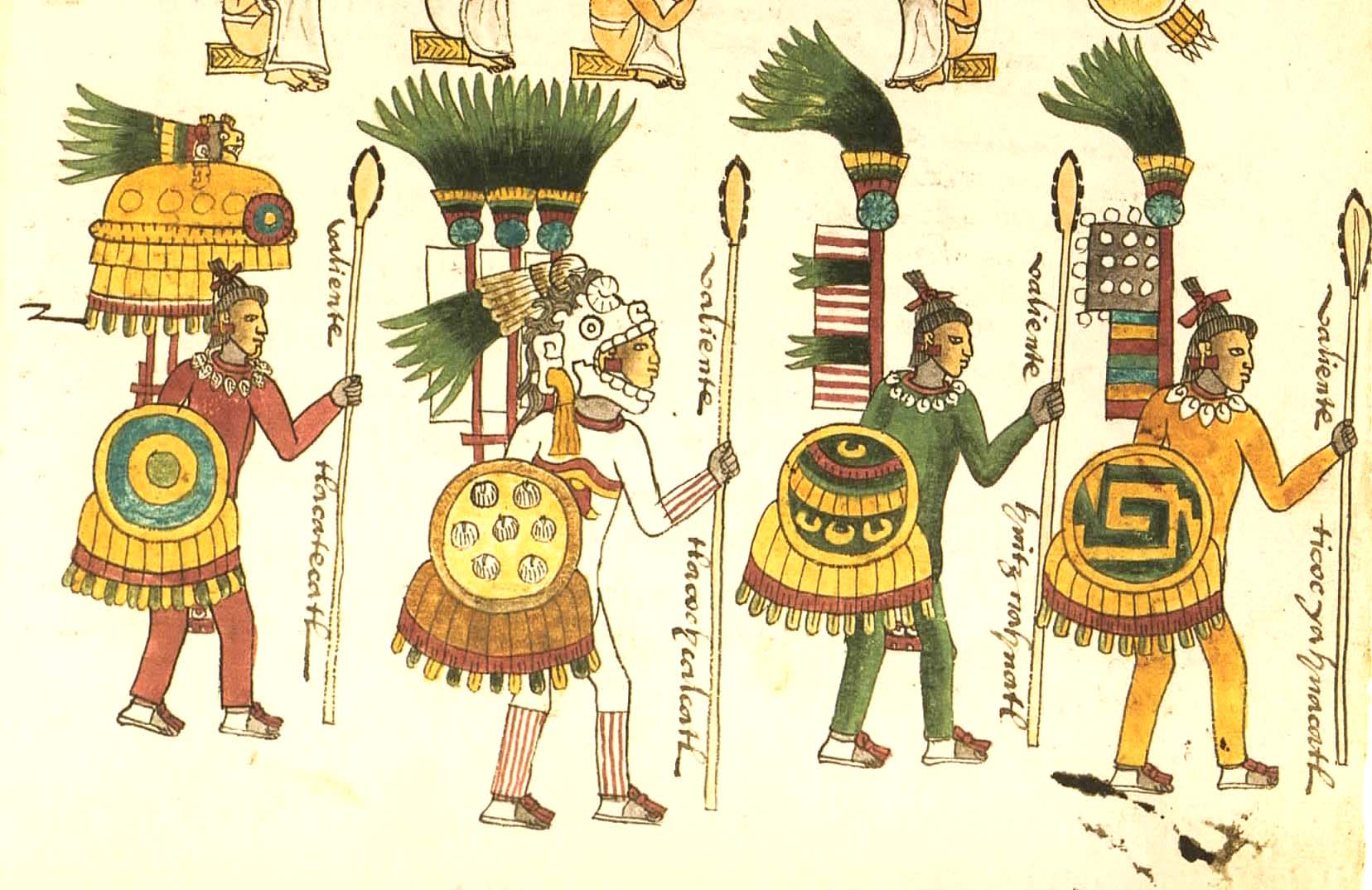
Commanders with standards from the Codex Mendoza. Note the elaborate costumes, use of feathers and the razor-sharp stone tipped tepoztopilli spears (usually five and a half feet long) of the officers.
File:Codex Mendoza folio 65r.jpgRanks awarded for captured prisoners and imperial officers, Codex Mendoza.
The capture of prisoners was one of the main goals of Central American Pre-Colombian wars. Those who were most successful quickly rose in rank and privileges within the army and society. Here in the codex are listed the stages of honors given to a warrior for the increasing numbers of prisoners captured. Note the sixth honor is entry into the elite Jaguar Warrior Class. The Lower eight figures are officers of the empire. The rank is delineated by the ever more elaborate feathers and costume design of the officers.
File:Florentine Codex IX Aztec Warriors.jpg
Warriors armed with the Maquahuitl (obsidian sword) and shield, note the eagle warrior in the lead, from the Florentine Codex.
Ranged weapons were varied and included:
File:Atlatl.png
The atlatl,a spear thrower that allowed longer range than a basic hand thrown spear.
The tlahuitolli, bow, ranged from light weight with short range weapons to some heavy weight that reportedly had a range of several hundred yards. All bows fired the mitl-stone tipped arrow.
The tematlatl was a sling made from maguey fiber. This was the ranged weapon most feared by the Spanish as it was often aimed at the unprotected face with deadly accuracy.
In addition to the maquahuitl and tepoztopilli, Aztec soldiers had access to a variety of additional wood and stone hand weapons.
The huitzauhqui was a club/mace sometimes with obsidian blades. These were about the size of a modern baseball bat but could be up to twice this size when yielded by a very strong warrior.
The tecpatl was a double-bladed dagger with a nine-inch length, excellent for close in fighting.
A weakness of all Aztec weapons was their stone and wood construction. The former dulled or chipped readily and the latter was no match against steel blades.
Protective gear/armor of the Aztecs was very minimal. It was designed to be light and give a limited protection against the stone tipped weapons of the Aztecs traditional Central American enemies. This equipment was basically made of two items the Chimalli and the Ichcahuipilli.

The Chimalli were small round shields made of wood or woven cane stalks often covered with cloth or feathers. They could be elaborately decorated for warriors of importance.

The Ichcahuipilli was a form of quilted cotton armor and inch or two thick. This padding was normally worn over the chest and back with the arms and legs unprotected. This gave such good protection against Indian stone tipped arrows that many Spanish soldiers would adopt this armor and continue to wear this style of protection when facing Indians well into the 18th century.
Eagle and Jaguar Warriors from the Codex Mendoza.

The tlahuiztli were the distinctive costume suits worn by the elite warrior classes. These usually covered the entire body including the head which often was covered in a form of helmet. These suits give a limited additional armor covering-especially if the costume included leather animal skins.
While adequate against their traditional enemies, the protective gear of the Aztec warriors was virtually useless against the steel weapons, iron tipped crossbow bolts, musket and cannon balls of the Spanish.
Aztec weapons could and did maim and kill their enemies who were similarly armed and protected. But in most conflicts capture of enemies was much preferred over killing them-dead men could not be sacrificed to the gods. So, it is not surprising that the majority of Aztec weapons could be readily used to stun an opponent to ease in his capture. This tactical choice and the limited strength of Aztec weapons and armor would prove a great hindrance to their army when they met the modern armed forces of the Spanish.