Showing posts with label Eastern Roman Empire (Byzantine Empire). Show all posts

Friday, February 2, 2024

Eastern Roman Empire Yes-Byzantine Empire No


Having lasted 1000 years, the Eastern Roman Empire was the most successful European empire in history. Founded in the 4th century before the fall of its more famous parent the Roman Empire. Its capital, Constantinople (modern day Istanbul), was created upon the site of the ancient Greek city of Byzantium by Roman Emperor Constantine I in 330 CE as his new capital for the Roman Empire. The Empire divided into the Eastern and Western Roman Empires in 395 CE.

With the death of the Western Roman Empire in the late 5th century, the Eastern Roman Empire maintained the laws, knowledge and culture of the Empire as Western Europe dissolved into scores of petty kingdoms, dukedoms, principalities and lesser states fell into what some historians refer to as the "Dark Ages."

At the height of its power, in the 6th century, under the Emperor Justinian I, the Eastern Roman Empire controlled most of the Mediterranean Sea coastal lands and the Middle East. Overtime Latin was replaced with Greek as the official language, and Orthodox Christianity became the main religion of the Empire.

Yet, until their lasts days, the people of the Eastern Roman Empire referred to themselves as "Romaioi" (Romans) and their last Emperor, Constantine XI Palaiologos, considered himself a continuation of the lineage of the Roman Emperors that began with Augustus in 27 BCE.

The name "Byzantine Empire" did not come into popular usage until after the fall of Constantinople to the Ottoman Empire in 1453. One reason for the name change appears to be the need of the intelligentsia of the Renaissance to claim direct linkage to the glories of the Roman Empire and reduce the importance of the continuation of that empire and its glories by "Eastern Peoples" who did not hold Western European cultural, social and religious ideals.

Elite Varangian Guards of the Eastern Roman Emperors. 
These Norsemen so impressed the rulers of the Eastern Roman Empire that they were the Emperors personal bodyguards for 300+ years (11th-14th centuries).

Saturday, February 13, 2016

Justinian and Theodora-Greatest Rulers of the Eastern Roman Empire

Justinian I the Great, Emperor (527-565) of the Eastern Roman Empire, the most successful of the emperors after the fall of the Western Roman Empire. His Justinian Code of Laws so revolutionized the legal system that the term "Code of Justice" is derived from his name.  He also had the largest domed cathedral in the World, the Hagia Sophia (Holy Wisdom) built.

Empress (527-548) Theodora was one of the greatest female leaders of the Roman Empire. During the Nika Riots of 532, she is credited as being the power, through her personal courage and convincing arguments, that kept Justinian from abandoning the throne (at the cost of up to 30,000 rioters' deaths).  Afterwards she was his most trusted advisor and with her support they reformed Constantinople and the Empire into a wonder of the World that would continue to keep alive the glories of the Romans for centuries to come. A strong supporter of the rights of women, she worked tirelessly to improve their status and legal standing in the Empire.

Monday, November 12, 2012

The Cataphract-Heavy Armored Cavalry

The cataphract was the Ancient Worlds "tank." Heavily armored and armed, the cataphract was the ultimate shock force of well-formed and trained armies, as only these could afford large units of these tremendously expensive cavalrymen. They were used the greatest and most effectively in the armies of the Eastern Roman (Byzantine) Empire and Persian Empire in the centuries before the formation of the European knights. For centuries, cataphracts ruled the battlefields of the East while Western Europe was in the throes of the Dark Ages.

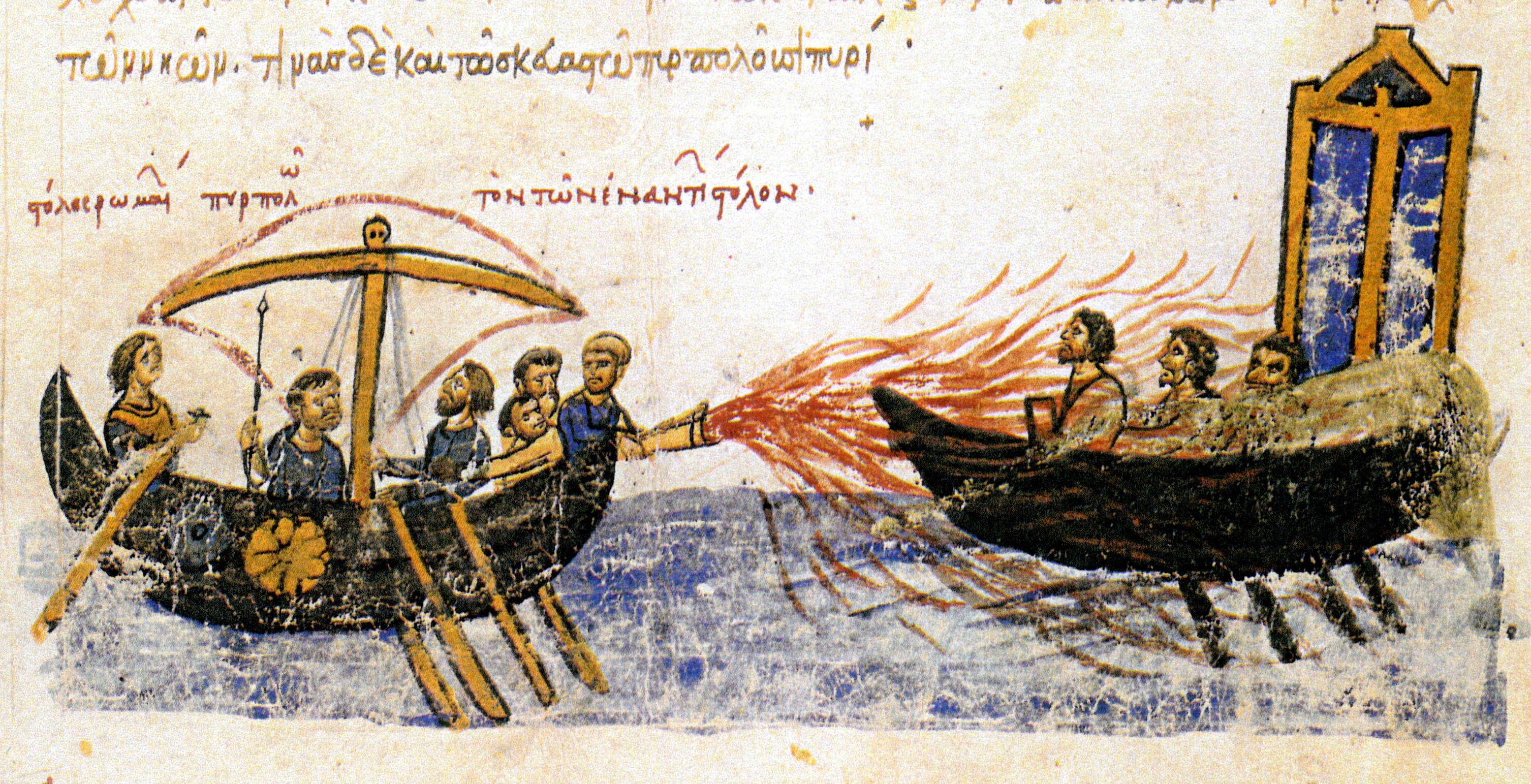
Greek Fire

File:Greekfire-madridskylitzes1.jpg

The greatest secret weapon of Eastern Roman Empire was Greek Fire, a ship born terror weapon that ignited on contact and burned on water. Fired from a brass tube, the flaming liquid was as devastating to morale as it was to the wooden ships of the era. It is thought to have been invented by a Jewish Syrian Engineer named Callinicus (Kallinikos) in the mid 7th century. To keep it from enemy hands, the secret formula was known to a very small number of people (around three). This is also the reason the formula is unknown today for by the mid 13th century, some tragic event killed all those with the knowledge before it could be passed on.

Wednesday, October 27, 2010

The Silk Road-the 1st Major International Trade Route

For more than a fifteen centuries goods and ideas traveled the mostly overland trades routes from East Asia, the subcontinent, and the Middle East to the lands of the Mediterranean. These routes are most often referred to as the "Silk Road" as this was the single most valuable commodity carried by the merchant traders.
Travel along these routes was dangerous and expensive. Every Empire, kingdom and city state along the Silk Road took their fair share of the profits through taxes, service charges and the like. From the cities of China to the great Eastern Roman city of Constantinople the goods flowed, and money flowed with them.  The massive wealth gained from this trade was a major reason for the long life of the Eastern Roman Empire (aka the Byzantine Empire)
But silk was not the only commodity carried, spices, gems, rare animals, slaves and numerous other valuable items traveled the route.
Gold flowed freely from West to East in a steady stream of negative trade balance from the coffers of the Europeans for the goods they treasured but could not produce.

An even more important item traveled with the merchants and their caravans-"ideas." Religions, inventions, such as paper (this is an ancient Chinese paper discussing Buddhism) stories, cultural concepts, all traveled along the Silk Road helping to spread the knowledge of mankind throughout three continents. On the negative side, contagious diseases such as the dreaded "Bubonic Plague" also traveled with the traders who used the Silk Road.

The Ottoman conquest of the Eastern Roman Empire did not end this trade, they simply increased the "carrying charges." The increased expense, and the possibility of cutting out the "Middleman" led several European kingdoms to look for alternate, cheaper trade routes. So, in 1492, a little-known Italian, sailing with three small Spanish ships set out for the riches of Asia and discovered a new world unknown to the peoples of the East and the history of mankind was massively changed forever.

Monday, October 25, 2010

Eastern Roman Empire-the Rome that Survived to the 15th Century

Most often called the Byzantium Empire by history, the Eastern Roman Empire far outlasted its more famous Western namesake. The trade of the Silk Road made the Eastern Roman Empire one of the richest empires of the pre-Renaissance World. This wealth was a major factor in the long survival of the Empire as well a major cause of its eventual conquest, as enemy after enemy was attracted to the untold riches the Empire held.

>Triple Walls of Emperor Theodosian

With its capital city of Constantinople protected by three sets of impregnable walls, the Eastern Roman Empire lasted almost a millennium after the fall of the Western Empire. The wealth of the Empire maintained these great fortifications as well as the excellent military need to defend them.


Justinian the Great brought the Eastern Empire to its highpoint of power and prestige. During his rule Latin was still the language of the Empire. As time passed Greek became the official language. Unfortunately, lesser emperors, civil wars and constant warfare with ever stronger enemies slowly whittled down the strength and borders of the Empire.

The Cathedral of Hagia Sophia, with its massive dome roof,is is an excellent example of the Roman engineering skills the Eastern Empire maintained for future rediscovery by Western Europe during the Renaissance.

The final collapse of the walls of Constantinople was brought about by a technology unknown to their builders-gunpowder. This 63cm (25 inch) siege cannon is similar to those that finally breached the walls of Constantinople in 1453 CE.

With the death of the last Eastern Roman Emperor, Constantine XI Palaiologos, at the hands of the Ottoman Turks of Mehmed II, twenty-two centuries of glorious and infamous rule of the Roman Empires ended, but not their influence. With the Renaissance, Western Europe rediscovered much of the knowledge of the Ancients, improved and expanded these ideas and eventually conquered the World, the Romans would have understood and been pleased.