Wednesday, April 25, 2012

Warfare in the Ancient Greek World

The armies of Ancient Greece were originally citizen forces where the individual was expected to equip himself with the majority of his supplies, weapons and armor.

The Hoplite armed with and eight-foot thrusting spear and curved short sword was the main fighting man of any Greek city state army.  His protective gear consisted of the best armor each man could personally afford.  The minimum would include a large round, wooden shield covered in bronze and a bronze helmet.  Those that could afford the best would also have a bronze (leather and stiffened linen were common for those with lesser funds) cuirass covering their chest and back and bronze greaves covering their lower legs.
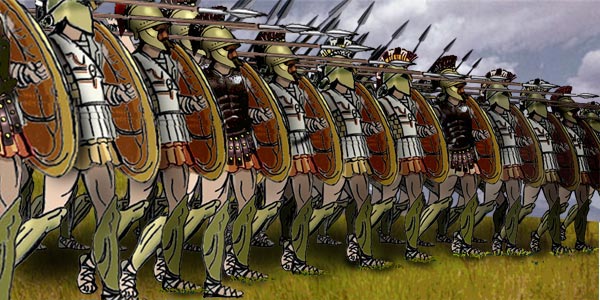
File:Greek Phalanx.jpg
The Hoplite Heavy Infantry Phalanx was the standard fighting formation.  Its strength was based on the coordinated defense of the overlapping shields and viscous killing power of the spears and swords.  Training, strength, stamina and bravery were key elements in the success of the phalanx. Battle were won or lost through the success of the phalanx.

The light infantry were armed with javelins or slings (occasionally with bows), a long knife or short sword was often carried for close combat. Their protection might include as much as a light curved shield and helmet (these were often called Peltast's) or as little as their normal clothing.  The job of the light infantry was to skirmish with the enemy and protect the flanks of the phalanx.

Unlike other armies of the time period, cavalry played a very limited role in Ancient Greek armies.  They were usual light cavalry with little or no armor and armed with javelins.  Their main role involved scouting and limited skirmish tactics.

The Galleon-work horse of the Spanish Empire


The Spanish Galleon became synonymous with trade and treasure in the 16th and 17th centuries. They were also the backbone warships of the major European navies of the day.
File:Vasas hull profile.jpg
Cross section of a typical galleon design. Note the two-gun decks, supplies stored in the lowest hold and the ballast stones that were critical to the ship's stability and one of the keyways to identify sunken shipwrecks to this very day. The latter was due to the fact that type of ballast stones unique as they came from streams and rivers near the shipyard that produced the ships.
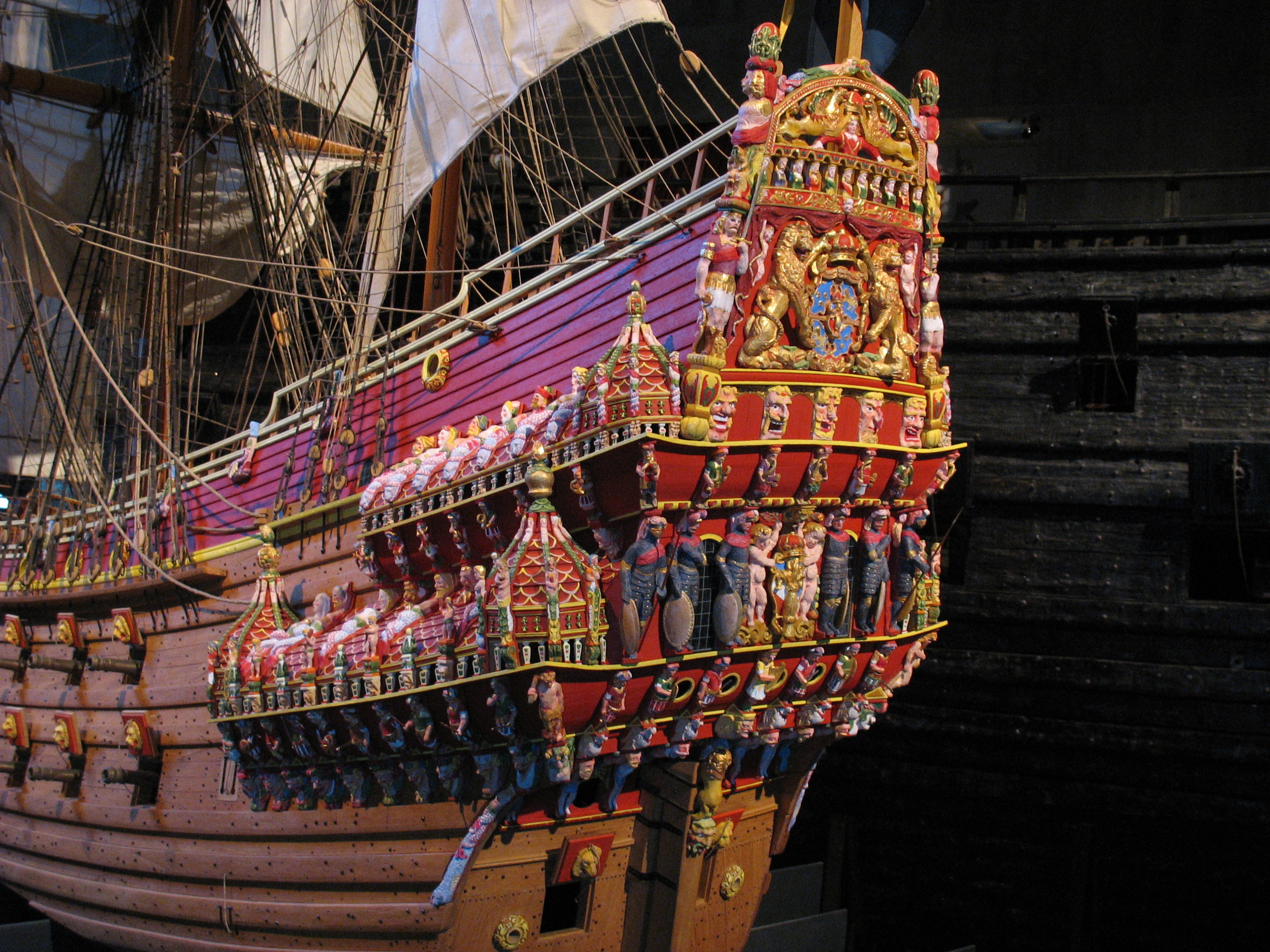
File:Vasa stern color model.jpg
Galleons were massive ships for their time and very expensive, they were therefore embellished with the finest craftsmanship and artistic designs affordable. The tall "castle" in the Stern was designed as an elevated fighting platform for the soldiers in the crew and was a hallmark of the galleon design.

From 1566 to 1790 the yearly "Treasure Fleet" transported the income of Spain's American Colonial Empire to Spain.  Fleets of twenty or more galleons would assemble in Cuba and sail in a convoy through the dangerous Caribbean waters (storms, Hurricanes and pirate/Privateer raiders being the greatest threats) to Europe.  In today's money it was not unusual for each treasure galleon to carry between 500 million and a billion dollars' worth of silver, gold, gems and jewelry on board-a tempting prize for pirates and the navies of Spain's enemies.

One a year from 1565 to 1815, the Manila-Acapulco Galleon, "the Black Ship," carried the years taxes, trade good and passengers from the Spanish East Indies in Asia to New Spain. The cargo then was transported overland to coastal seaports to join the annual Treasure Fleet to Spain.
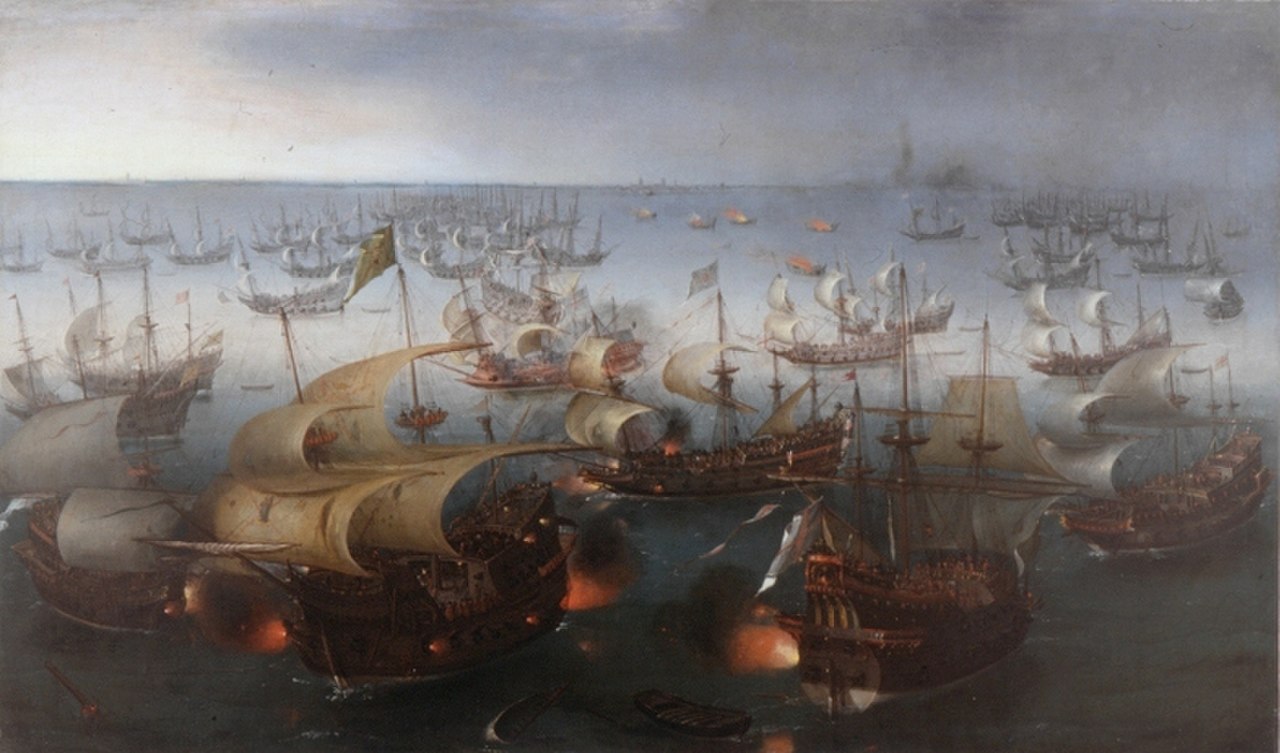
File:Invincible Armada.jpg
File:Vroom Hendrick Cornelisz Battle between England and Spain 1601.jpg
 In large scale sea battles, Galleons were the major warships of the age.  Most galleon were armed with forty to sixty cannon and hundreds of soldiers.  The main tactic was to fire the ships cannon while closing with the enemy.  When the ships were close enough to grapple (throw ropes with hooks to catch and pull the enemy ship towards the attacker) the soldiers would board the opponent and capture them through hand-to-hand combat. 

As with all military technologies, the Galleon was eventually superseded by newer designs and technological advances. By the 18th century Galleons were but memories of a more "romantic" age.

Tuesday, April 24, 2012

From Reconquista to the New World

From the first Muslim invasions of the Iberian Peninsula in the 8th century to the last decades of the15th century, the Christian rulers of the various kingdoms of this land fought to retake the land in the name of Christ. As the centuries progressed more and more of the lands were retaken through the "Reconquista."

File:Coat of Arms of Queen Isabella of Castile (1492-1504).svg
By 1492, the monarchs Queen Isabella of Castile & Leon and King Ferdinand of Aragon (both descended from the king of Leon) had married, uniting their joint kingdoms into what would become Spain and completed the Reconquista by eliminating Granada, the last Muslim stronghold in Western Europe.

One of the benefits of the final actions of the Reconquista was the "liberation" of land, properties and much of the wealth of the Muslims.  A large portion of these riches now came into the hands of the King and Queen, just in time to fund a risky venture to discover a shorter trade route to India under the command of one Cristóbal Colón. 
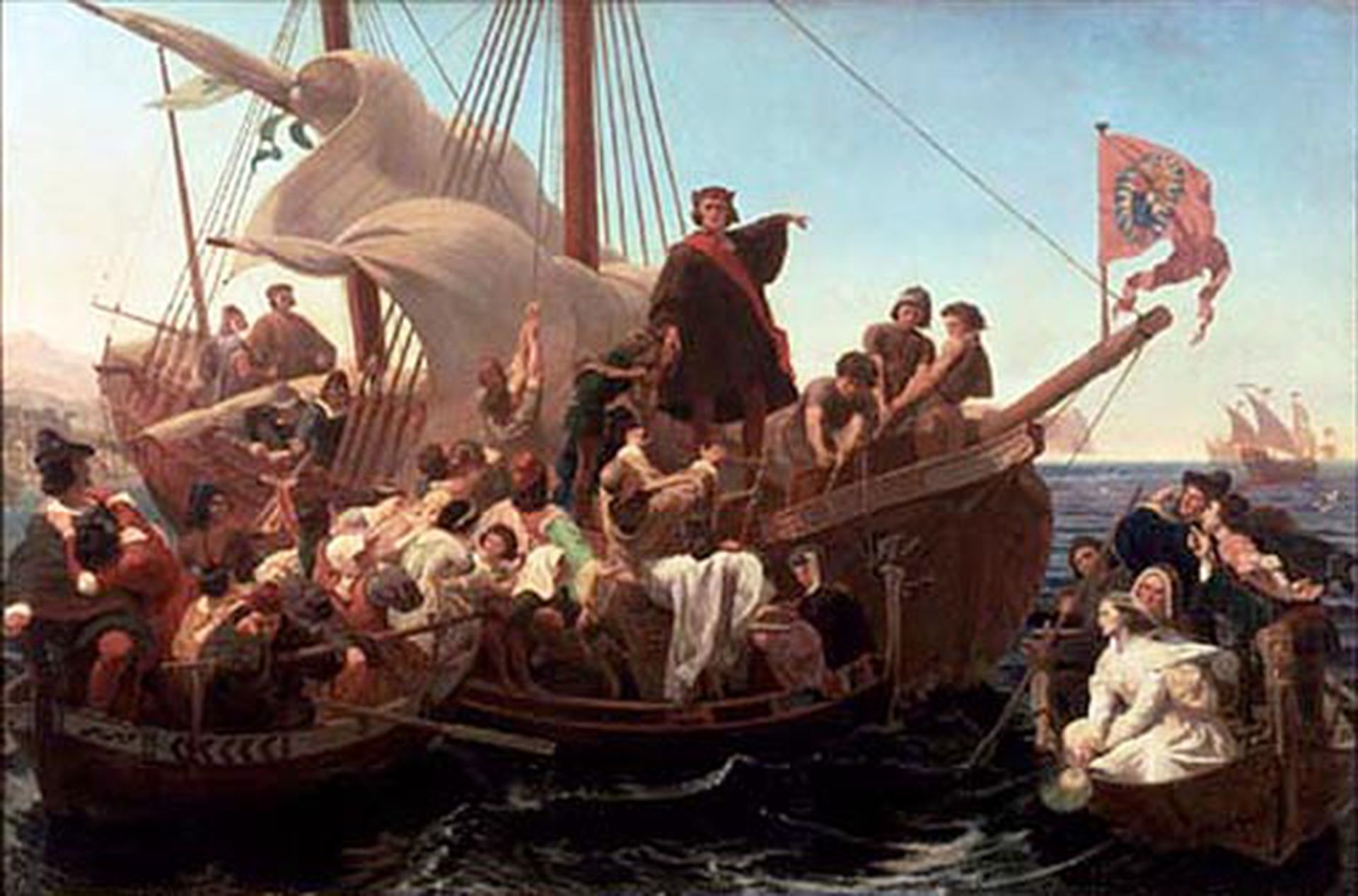
File:Christopher Columbus on Santa Maria in 1492..jpg
In 1493, Cristóbal Colón returned to Spain claiming to have found a new route to Asia and the "Indies."  It would take several more voyages by multiple European Explorers to eventual establish that Colón had actually discovered a hitherto unknown land-"the New World." The centuries long Reconquista to retake the Iberian Peninsula for Christianity now lead to the opening of entire "new" continents to colonization and religious conversion.

Friday, March 9, 2012

Results of the 14th Century Black Death


In what has been the largest pandemic percentage killings of humans in the last 2000 years, 1/3 of the population of Europe,  around 25 million,  died in just under five years between 1347 and 1352 as a result of the dreaded Black Death-the Bubonic Plague.


Estimated population of Europe from 1000 to 1352:

                                                                    1000-38 million,
 1100-48 million,
1200 59-million,
1300-70 million,
1347-75 million
1352-50 million
But out of death and loss a new World emerged-the rebirth of Europe was at hand,
the Renaissance
The huge death toll left a massive shortage in the labor force.  Over night serfdom began to disappear and a large middle class, something unknown in Europe since the Roman Republic of 100 B.C.E., began to emerge.  The plague aided the development of the Renaissance as men with talent were able to rise above their station of birth due to the more fluid social order.  The World would never be the same!

Wednesday, March 7, 2012

Machiavelli and "the Prince"


Niccolò Machiavelli 1469-1527,

In a time where most believed that "Good Moral" leaders were also "Good Political " leaders and ruled with the "Grace" of God, Machiavelli wrote a divergence view of the power of a leader and the State.  In his most famous work The Prince (Il Principe), he made the case that power, not the moral character, defines political action.  To be an effective leader, one must understand the proper use of power and its application to the control of and success of the State. Individuals of the State must be brought to obey this power thereby maintaining the success and security of the State and all its citizens.  In Machiavelli's eyes a leader that is respected (or even feared) for his power will be more successful than one who is admired for his "Goodness."

The Prince puts forth the belief that the goal of a leader should always be to “maintain his state” and to “achieve great things,” both of which require power and will increase the power of the ruler.  Many have interpreted his arguments as justification for the adage-"the ends justify the means" where upon rulers are allowed to do what they wish in the stated goal of protecting the State.  Others believe that Machiavelli was exposing the dangers and threats of single dictatorial rule.  What is clear is that many leaders have read and followed his teachings, to both the betterment and sufferings of their peoples and States.

(Other notable works by Machiavelli included Dell’Arte della Guerra [the Art of War], Ritracto delle cose della Magna [Portrait of the affairs of Germany] and Discorsi sopra la prima deca di Tito Livio [Discourses on the First Ten Books of Titus Livy])

Tuesday, March 6, 2012

Results of the Crusades


As in all major historic events, the results of the Crusades were varied, complex and open to discussion as to their true effect upon World History. That being said there are some very important historic trends that can be seen as stemming from the Crusades:

 Kingdoms of Europe are the now the norm, the chance of a United Europe under the leadership of the Church or single powerful leader is gone. Much of the wealth taken from the looting of the cities of the Middle East and new trade will pay for the growth of the more powerful of these kingdoms.

 Distrust, Dislike and Outright Hatred between Christian and Muslims is now common due to the acts of bloody massacre and intolerance, accomplished “in God’s Name,” by the warriors and leaders of each group towards their "Enemies of the True Faith."


 The Europeans desire for lost and new knowledge and Eastern trade goods, especially spices, is multiplied throughout Europe by the Crusaders hundred-year+ presence in the Middle East terminus of the Silk and Spice Roads.  This will lead to ever more expeditions looking for faster, cheaper and more profitable trade routes to “India and China.”  These trade routes will require save havens, “Colonies,” for the Europeans as they travel from the West to the East.

 Europe is once again interested in the rest of the World, a concept that had lain dormant in the West since the fall of the Western Roman Empire.  More effort to understand the World, map the World and own their fair share of the World will consume the minds and energies of generations of European leaders, explorers, merchants and warriors.

 Europe will now step on to the road of World conquest, slow at first but increasing in effort and violence faster as the centuries roll on. This conquest will continue, eventually resulting in the massive colonial Empires of the 19th/20th centuries, causing political, social and economic problems that the World still faces in the 21st century.


Friday, March 2, 2012

Culture of the Mexica-Aztecs


Lake Texcoco was the home of the capital city of the Aztecs-Tenochtitlan. Built on a lake with canals for streets, the Spanish called this beautiful city the "Venice of the Americas."


The Aztec dike protecting Tenochtitlan from floods is visible on the lower half of this Spanish map of the city.


As with all cultures, food was a daily necessity. Many of the foods the Aztecs ate have become common place in our world today, corn (maize), chili, tamales, tortillas and salsa were all introduced to the Europeans through contact with the Aztec Empire.


A favorite drink of the Aztec elite was chocolate.
This scene is from the Nuttall Codex showing where a cup of foaming chocolate is exchanged at a marriage. The Aztec version of drinking chocolate was not sweet, it was spiced with hot peppers. After the conquest, the Spanish were the first to add sugar to the drink.


Aztec weapons were made of stone and wood. The Aztec Maquahuitl warclub/sword was a fearsome weapon used obsidian stone blades. The blades were razor sharp but virtually useless against the steel armor and weapons of the Spanish.


Education was mandatory for all Aztec children; great store was put into the concept that knowledge strengthened the society.


Ullamaliztli-The main Ball Game of the Aztecs. On important religious occasions the losing team was often sacrificed to the gods.


The full Ullamaliztli ball court with the hoops in opposite walls. Similar to soccer, the ball could not be touched with the hands.  The object was to have the ball go through the small stone hoop at the center of either wall. 


Human sacrifice was seen as necessary to feed the gods. The Aztecs believed that without the most precious thing on earth, human life, the gods would die and the World would end. The numbers of lives given to the gods is unknown, some sources say hundreds a year, some say thousands and others estimate tens of thousands per year. Nothing convinced the Spanish that the Aztecs were barbarian more than this aspect of the culture of the Mexica.


Jaguar brazier used to burn the hearts of sacrificial victims so to speed their way to the gods.


Temple complex of Tenochtitlan.


This pair of Aztec warrior effigy incense burners were found at the entrance of a tomb.


Aztec warriors were proud, brave men who wore elaborate colorful costumes and jewelry into battle.  The more important the warrior the fancier the outfit he wore.


Surrender of Cuauhtemoc, the last Aztec Emperor, to Cortez (note Dona Marina at the side of Cortez-her revenge is complete). In 1525 the Spanish executed Cuauhtemoc officially ending the Aztec Empire.